Comparing images
--diff answers a question a pixel comparison cannot: would a person notice,
and where?
Compare two images byte for byte and anything regenerated — artwork, anti-aliased text, a re-encoded screenshot — reports as almost entirely changed. On the pair used throughout this page a plain comparison calls 42% of the canvas different, with a bounding box covering three quarters of the frame. True, and useless.
The perceptual pipeline reports 5.4%, and points at the one region that matters.
How it decides
- Blur both images, so sub-pixel noise and re-encoding artefacts stop registering as change.
- Convert to CIELAB, where Euclidean distance approximates perceived difference. In RGB a shift in dark blue and the same numeric shift in mid-green look identical to the arithmetic and nothing alike to the eye.
- ΔE per pixel (CIE76), then threshold.
- Morphological open — erode, then dilate — dropping speckle while leaving surviving areas their original size.
- Label connected components and rank them by area × severity, so the report leads with what a person would point at first.
The output
Two parts. The picture shows where; the table is the part that survives a pipe, a log, and a CI transcript.
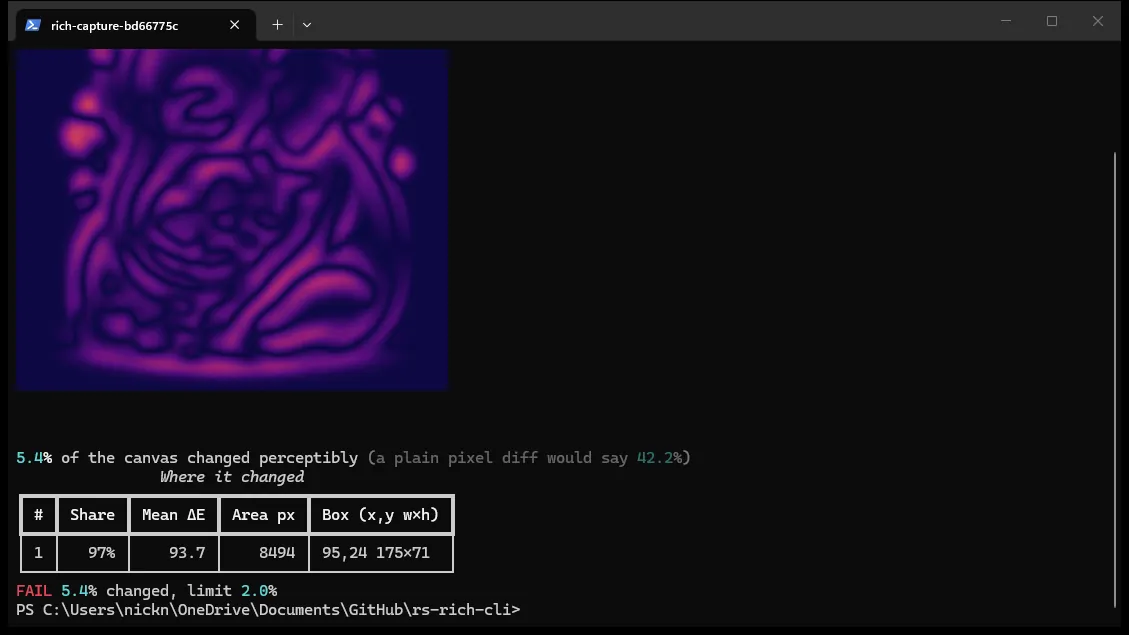
Share is the region's portion of all changed pixels — including components
too small to be listed, so the shares do not sum to 100%. Mean ΔE is how
strong the change is, independent of how large.
Choosing how the picture is drawn
| mode | what it does |
|---|---|
auto |
Sixel where it looks supported, else blocks, else ascii (default) |
sixel |
Real pixels via the Sixel graphics protocol |
blocks |
Half-block characters — any truecolour terminal |
ascii |
A character ramp; the only mode that needs no colour |
none |
Numbers only |
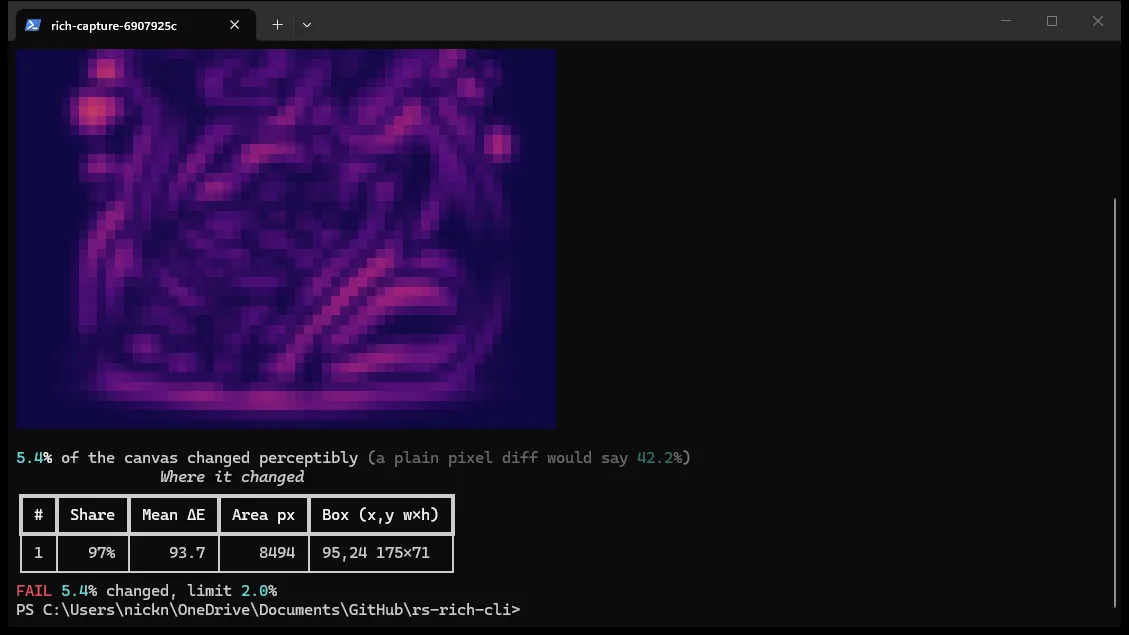
blocks packs two pixel rows into each character cell as ▀, foreground
over background. Every cell is painted, so there are no gaps, but a cell can
only carry two colours — hence the visible stair-stepping.
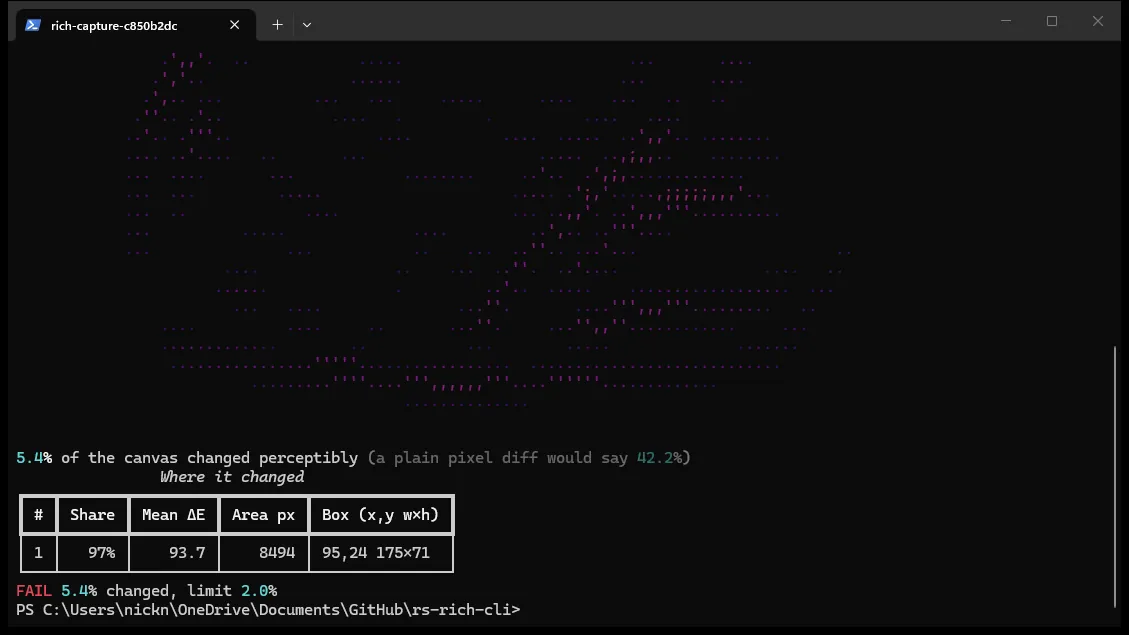
ascii maps each pixel to a character from a ramp. Dark pixels become
spaces, so a heat map arrives full of holes. It is the right answer for line art
and for terminals with no colour at all, and the wrong one for anything
photographic — included here because that trade-off is worth seeing rather than
being told about.
Why this is a picker and not just detection
There is no reliable way to ask a terminal whether it renders Sixel. The correct
probe is a DA1 query needing a round trip on a tty, which is unavailable when
output is piped, and terminals that ignore the query leave you waiting. auto
is therefore a heuristic over environment variables and will be wrong
somewhere.
So the guess is overridable at every level: --image-mode beats everything, and
RICH_SIXEL=0/1 beats the heuristic.
Every mode degrades rather than failing. Sixel is a control sequence, so it only works on a terminal. Redirected output falls back to ASCII; exports use blocks (or ASCII without colour). Blocks need colour, so without it they fall back to ASCII, since a half-block render with no colour is a rectangle of identical characters carrying no information. Each downgrade prints a line to stderr saying what it did, so the change is visible rather than mysterious, and stderr keeps it out of a redirected report.
As a CI gate
Exits non-zero when more than 2% of the canvas has changed perceptibly, so visual regressions fail a build. The threshold is compared against the perceptual figure, never the naive one — gating on a byte comparison is what makes visual regression testing unusable, because every re-render trips it.
The comparison uses both percentages as printed, with the same one-decimal
rounding, so equal displayed values pass. For example, a threshold of 5.39
prints as 5.4% and passes a displayed change of 5.4%; 5.34 prints as 5.3%
and fails that change. A threshold outside 0–100, or one that is not a real number,
is rejected: NaN parses successfully as a float and compares false against
everything, so accepting it would silently switch the gate off and report a pass.
Everything the gate prints goes to stdout; only the downgrade notices above use stderr.
--threshold and --image-mode are refused without --diff rather than
ignored. Silently accepting them meant a job that lost its --diff — a typo, a
refactor, an argument reordered — became a permanently green gate, which is the
same failure an unvalidated threshold caused.
Tuning
These are not exposed on the command line yet — they are listed so the
output can be interpreted, not adjusted. --threshold gates the result; it
does not change the ΔE threshold below. Callers of the rich-art crate can set
all four through DiffSettings.
Defaults are tuned for regenerated artwork, where noise is heavy. Screenshot pairs are far cleaner and would tolerate a much lower ΔE threshold.
| setting | default | effect |
|---|---|---|
| blur radius | 6.0 | higher ignores more fine detail |
| ΔE threshold | 60.0 | higher reports only stronger changes |
| open kernel | 11 | larger discards bigger speckles |
| minimum region | 400 px | smaller regions are not listed |
Images of differing sizes are refused rather than compared: every pixel past the smaller extent would read as changed, which is not a meaningful answer.
Accuracy
The pipeline is verified against a Python reference implementation using
scipy.ndimage, in the same arrangement capture_golden.py provides for render
parity. On the full-size reference pair the two agree on region count and rank
order, positions to within 1–3 px, areas to within 0.1–2.1%, and mean ΔE to one
decimal place.
The residual is one known difference: PIL's GaussianBlur approximates a
Gaussian with three box passes, where this uses a true separable Gaussian. That
moves the ΔE threshold boundary by a pixel or so, which nudges region edges. The
parity test pins the agreement rather than claiming it is exact.