More capabilities
Experimental
Everything on this page is a preview. Output formats will change.
Entity-relationship diagrams
ods erd generate draws the keys and relationships your project already asserts, or
already uses:
uniqueandnot_nulltests,dbt_utils.unique_combination_of_columns, and a model'sunique_keyconfig make keys, including keys over several columns;relationshipstests and contract constraints make references;- joins in the project's own SQL make references too, so projects without
relationshipstests still get a diagram.
Every key and relationship is labelled declared, tested, joined or inferred. When neither side of a join is a known key, its cardinality is shown as unknown rather than guessed. Here is the demo project's diagram, showing key columns only:
erDiagram
    customer_order_rank {
        INTEGER order_id FK
        INTEGER customer_id PK
        BIGINT order_seq PK
    }
    customers {
        INTEGER customer_id PK "tested key"
    }
    orders {
        INTEGER order_id PK
        INTEGER customer_id FK
    }
    stg_orders {
        INTEGER order_id PK "tested key"
    }
    stg_payments {
        INTEGER payment_id PK "tested key"
        INTEGER order_id FK
    }
    customer_order_rank |o--o| orders : "order_id"
    orders }o--o| customers : "customer_id"
    orders }o--o{ stg_customers : "customer_id (joined)"
    stg_payments }o--o| stg_orders : "order_id"
Details: CLI reference, ADR-0012.
MCP server for AI agents
ods mcp serves the ODS engines to AI agents over the
Model Context Protocol, on stdio. It is read-only
and local: it needs no login, makes no outbound network connections and collects no
telemetry. No tool writes files, runs dbt or queries a warehouse.
claude mcp add ods -- ods mcp --target-dir target
{ "mcpServers": { "ods": { "command": "ods", "args": ["mcp", "--target-dir", "target"] } } }
For analytics engineers, the tools answer: where a column comes from, what a change affects, which tests are missing, and where lineage is unknown.
For people who use the data but don't know the project, three tools help answer a business question with SQL:
ods_find_datafinds tables and columns by meaning, and says what one row is;ods_describe_entityexplains a table: its grain, columns and what it joins to;ods_plan_queryreturns the most trustworthy join path and a starting SQL query, and warns when a join would repeat rows.
The agent writes the final query using only columns and joins those tools returned. Always review generated SQL before relying on its results.
Details: CLI reference, ADR-0010.
State: what to build, what to reuse
ods state plan compares the project with its last successful build and says, per
node, build or reuse, with the reason and the evidence. That includes which parts
of a model's code changed, which upstream data is new, and whether a lag tolerance
defers it. It prints the dbt build --select … command for exactly what must run.
ods state record takes the state from the dbt runs you already do: only nodes that
succeeded advance.
$ ods state plan          # after editing stg_orders and running dbt compile
decision: 8 to build, 5 to reuse

node                     action  why
raw_orders               reuse   code and inputs unchanged since run d11a1309…
stg_customers            reuse   code and inputs unchanged since run d11a1309…
stg_orders               build   code changed since run d11a1309…: sql
orders                   build   upstream code changed: stg_orders will be rebuilt
customers                build   upstream code changed: orders will be rebuilt
customer_segments        build   upstream code changed: customers will be rebuilt
segment_summary          build   upstream code changed: customer_segments will be rebuilt
…
run: dbt build --select stg_orders order_events orders customer_order_rank customers customer_segments customers_snapshot_view segment_summary
(Output shortened; from the demo project.)
Comments and whitespace don't count as changes: reformatting a model reuses it, and the plan says only formatting changed.
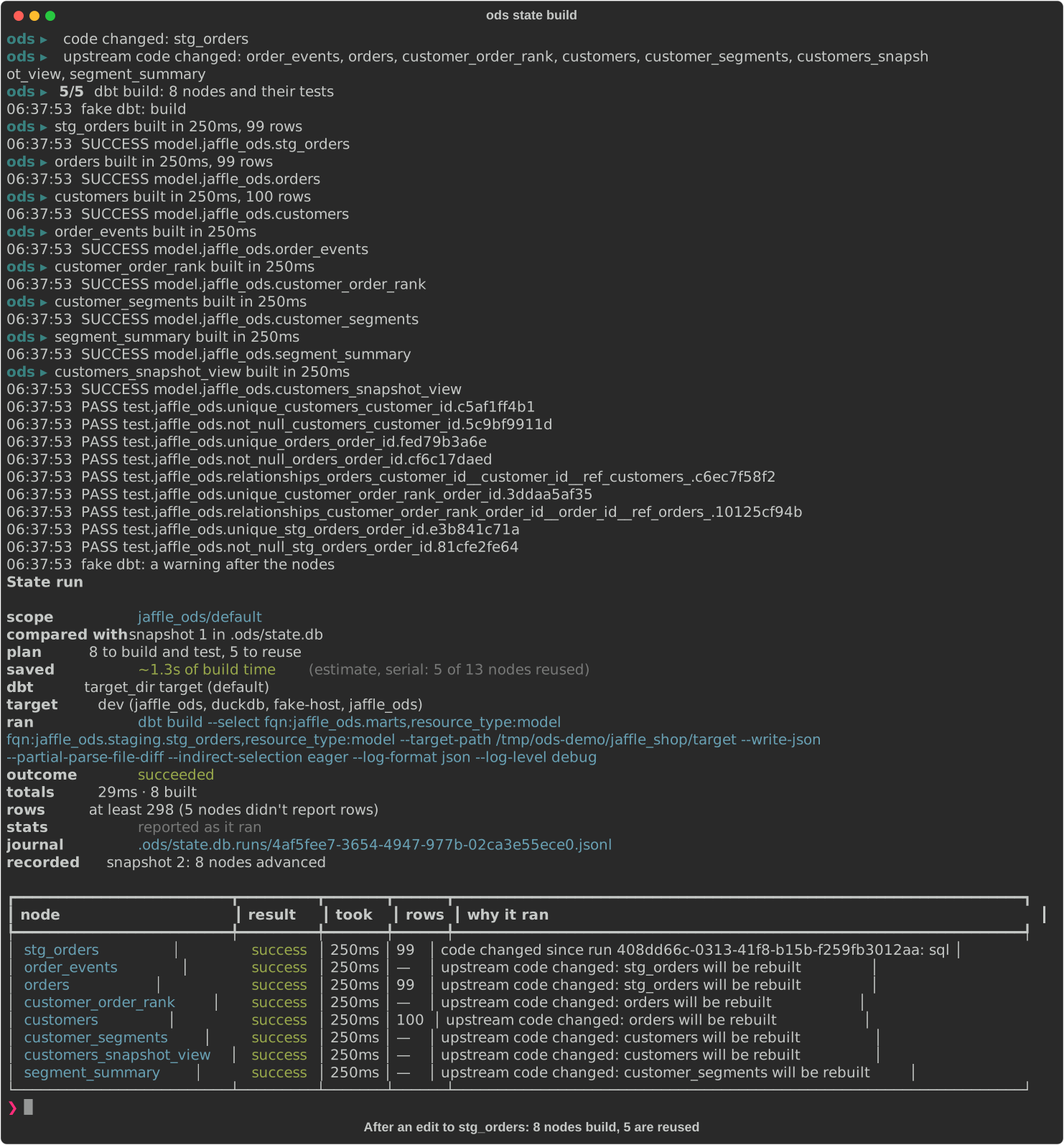
ods state build does all of it: it measures sources, compiles, plans, runs
dbt build on exactly the nodes that must build, and records the result
(ods state run, seed, snapshot and test do the same with their dbt namesakes).
Nodes that fail keep their last successful state and are built next time;
ods state retry --failed builds only those.
As dbt runs, each node's result is a line on the terminal; the report then gives every
node's result, time taken and rows, and why it ran. Rows the adapter doesn't report
read —, never 0, and the total says "at least N". Every run's events are kept in a
journal beside the state database, so ods state history --run <run_id> shows them
later, even for a run that failed and recorded nothing.
Details: CLI reference, ADR-0013, ADR-0014, ADR-0024.
dbt State configuration
ods state policies reads dbt's State configuration (lag_tolerance,
require_fresh_data_from, build_after) as you already write it, and shows each
model's effective freshness policy: the lag tolerances the State planner applies.
Details: CLI reference, ADR-0011.