Column-level lineage
Experimental
Lineage is ODS's most developed capability, but it is still a preview. Check surprising results against the SQL, and please report them.
ods lineage parses every model's compiled SQL and works out, for each output
column, which upstream columns feed it and how. It also records which columns
decide which rows exist. It reads only dbt's artifacts, with no dbt login and no
warehouse connection.
Try the live demo
Open the lineage explorer on the demo project :material-open-in-new:
The demo is jaffle-ods, a small dbt project in the repository (fixtures/dbt/). This
site's build generates the explorer from it with ods lineage view --site. Search a
column (press /), click it to highlight everything upstream (blue) and downstream
(orange), and toggle indirect edges.
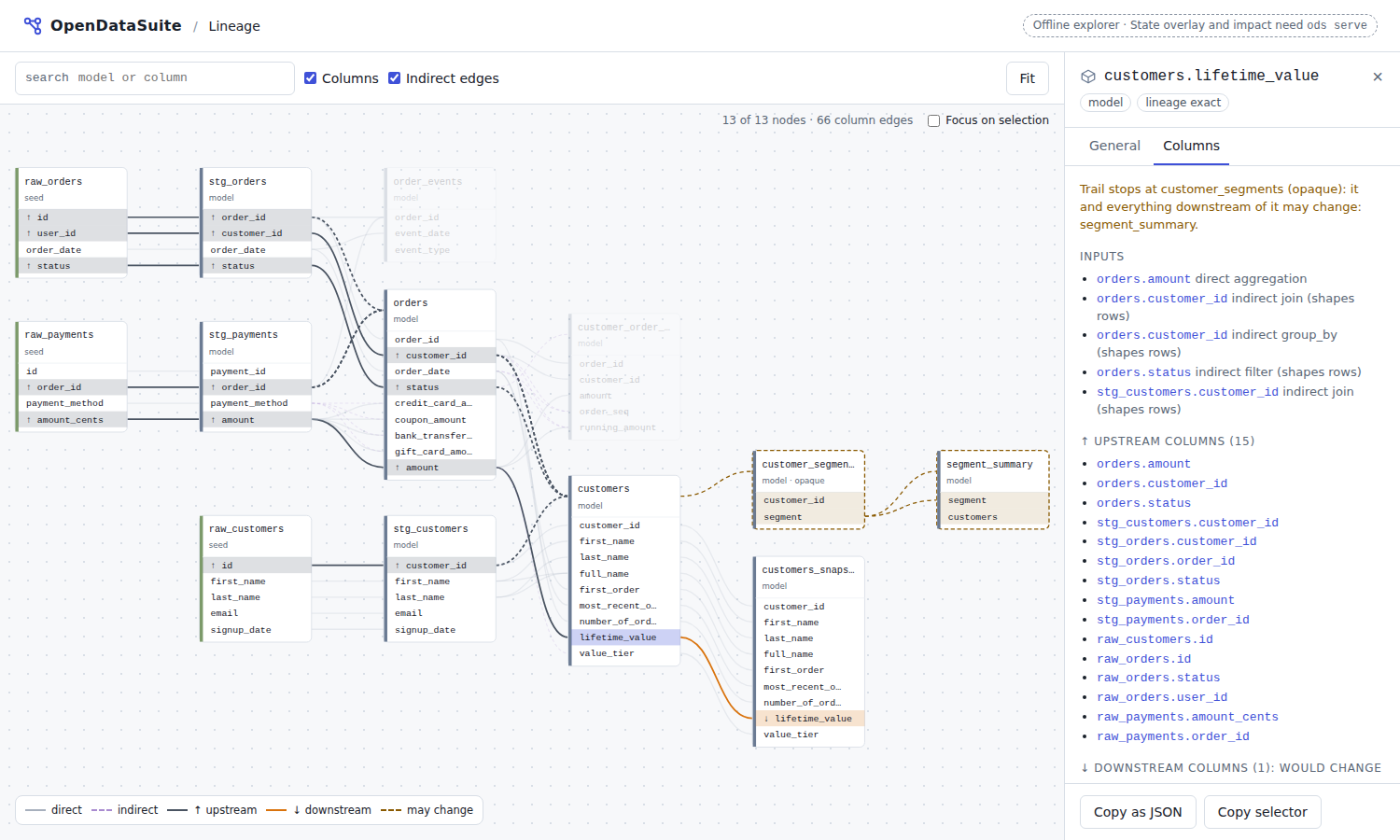
ods serve shows the same explorer inside the dashboard, where a State overlay
colours each node by what the next run does with it (build or reuse) and why; see
the Lineage page.
Where does each column come from?
$ ods lineage columns --model customers
customers
  customer_id
    stg_customers.customer_id (identity)
  full_name
    stg_customers.first_name (transformation)
    stg_customers.last_name (transformation)
  first_order
    orders.order_date (aggregation)
  lifetime_value
    orders.amount (aggregation)
  value_tier
    orders.amount (indirect:conditional)
  rows shaped by
    orders.customer_id (indirect:join)
    orders.customer_id (indirect:group_by)
    orders.status (indirect:filter)
(Output shortened.) Every edge has a kind:
| Kind | Meaning |
|---|---|
identity |
the value is copied unchanged |
transformation |
the value is computed from the input (first_name || ' ' || last_name) |
aggregation |
the value is aggregated from the input (sum(amount)) |
indirect:* |
the input doesn't flow into the value but shapes it or the rows: join, filter, group_by, conditional, window ordering |
Edges are traced through CTEs, subqueries, select *, unions and window functions,
to physical columns.
Change impact
ods lineage impact answers "what must run if this changes, and what can be skipped?"
$ ods lineage impact --column stg_orders.status
changes: 1
must run: 4
pruned: 1

model.jaffle_ods.orders
  changed columns: status
  jaffle_ods.main.stg_orders.status modified → `status` (identity)

model.jaffle_ods.customers
  all rows may change
  jaffle_ods.main.orders.status modified → its rows (indirect:filter)
…
Skipped: they read changed models but none of the changed columns
model                        reads                       unused changed columns
model.jaffle_ods.order_events  jaffle_ods.main.stg_orders  status
Impact is decided conservatively:
- A model ODS can't analyze (a Python model, unsupported SQL,
select *over unknown columns) is opaque. Any change to what it reads makes it run. - A change to a column that decides which rows exist (a filter, join or grouping) makes every reader run.
- A modified or removed column makes a reader run only if it uses that column.
- Every reader that is skipped is listed, with the changed columns it doesn't use, so you can check the reasoning.
Compare two whole builds with --base ../prod/target. Every difference in compiled
SQL becomes column changes.
Export and share
| Command | Output |
|---|---|
ods lineage view |
one offline HTML file, or a static site with --site DIR |
ods serve |
the explorer plus a read-only JSON API, reloading when artifacts change |
ods lineage graph --format … |
json (documented, schema_version 1), Graphviz dot, mermaid, graphml |
ods lineage export |
OpenLineage events, for catalogs that accept them |
Observed lineage from the warehouse
Databricks Unity Catalog records column lineage for the queries it runs, including Python. ODS can read an export of that table; it doesn't connect to the workspace itself:
ods lineage comparechecks the static analysis against what actually ran;--observed FILEfills in models the analyzer can't read, labelledobserved.
Limits today
- SQL dialects: Databricks/Spark, DuckDB, Snowflake, BigQuery, Postgres, Redshift and a generic dialect. Unusual syntax can make a model opaque; ODS says so rather than guessing.
- Macros are seen only as the SQL they compile to.
- Python models are opaque without observed lineage: anything they read may affect
every column, so they run whenever their inputs change. OpenLineage export still
gives them table-level lineage. The demo project has one (
customer_segments), with a SQL model reading it. - Seed columns come from the catalog, or else from the seed's CSV header when it matches dbt's checksum. The Information Schema has no seed checksum, so there the catalog is needed.
Full flags are in the CLI reference. The design is in ADR-0008.