Documents: Org, AsciiDoc and man pages
rich_ext::document draws documentation formats beside core's Markdown:
Org, AsciiDoc and man pages from their roff source, with
reStructuredText (rich_ext::rst, a port of rich-rst) and Markdown itself
behind the same interface. Upstream rich renders Markdown only; this
module is the port's own (behind the default syntax feature).
The three new formats parse into one small model, and DocumentView draws it
with core's renderables in Markdown's look: the same heading styles, bullets
and numbers, code panels, tables, block quotes and rules. Every snippet comes
from
guide_documents.rs:
Render a document
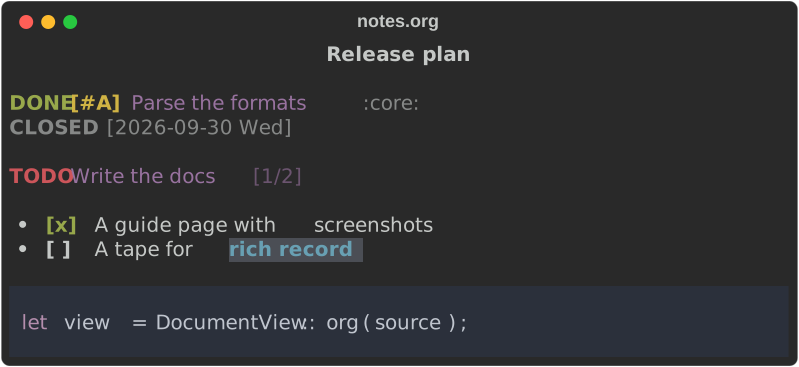
Headlines keep their TODO keyword (TODO/DONE, or the ones a #+TODO:
line declares), priority and tags; drawers, planning lines and keywords such
as #+OPTIONS are shown dim and compact under what they belong to.
fn show_asciidoc(console: &Console) {
    // Without hyperlinks a link's target is written out, as `rich` does
    // unless `-y` asks for terminal hyperlinks.
    console.print(&DocumentView::asciidoc(ASCIIDOC).hyperlinks(false));
}
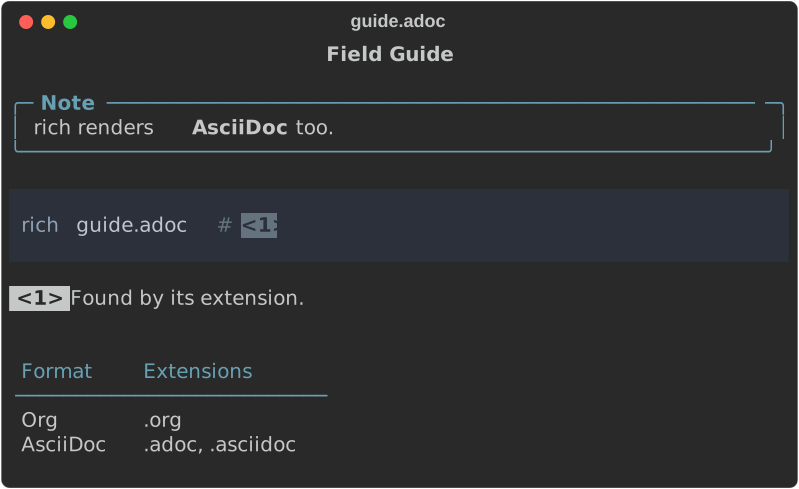
Attribute entries (:product: rich) fill {product} references; admonitions
are titled panels; callout markers (<1>) are drawn the same in the code and
in the list that explains them.
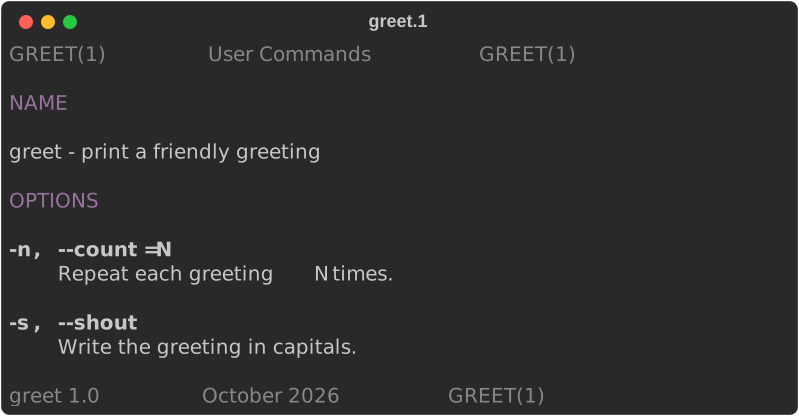
.TH becomes the page's running header and footer, .SH/.SS headings,
.TP and .IP tagged paragraphs a definition list (or a bullet or numbered
list when the tag is one), and the font escapes bold, italic and code spans.
DocumentView takes the same options as Markdown: .hyperlinks(false)
writes a link's target after its text (core's Markdown::hyperlinks), and
.code_theme(…), .default_language(…) and .fence_renderer(…) reach the
code blocks.
Detect the format
A DocumentRegistry holds the formats and finds one from a path and the
text:
fn show_detect(console: &Console) {
    let registry = DocumentRegistry::with_builtins();
    let mut table = Table::new();
    for header in ["Path", "Content", "Format", "Confidence", "By"] {
        table.add_column(header);
    }
    for (path, content) in [
        (Some("notes.org"), ""),
        (Some("ls.1"), MAN),
        (Some("syslog.1"), "Jan 1 boot ok\n"),
        (Some("gen.c"), MAN),
        (Some("GREET"), MAN),
        (None, ORG),
    ] {
        let detected = registry.detect(path, content, CERTAIN);
        let (format, confidence, by) = match &detected {
            Some(found) => (
                found.format.clone(),
                format!("{:.2}", found.confidence),
                format!("{:?}", found.by),
            ),
            None => ("—".into(), "".into(), "".into()),
        };
        let shown = content.lines().next().unwrap_or("");
        table.add_row_text(vec![
            Text::new(path.unwrap_or("<stdin>")),
            Text::new(shown.chars().take(18).collect::<String>()),
            Text::new(format),
            Text::new(confidence),
            Text::new(by),
        ]);
    }
    console.print(&table);
}
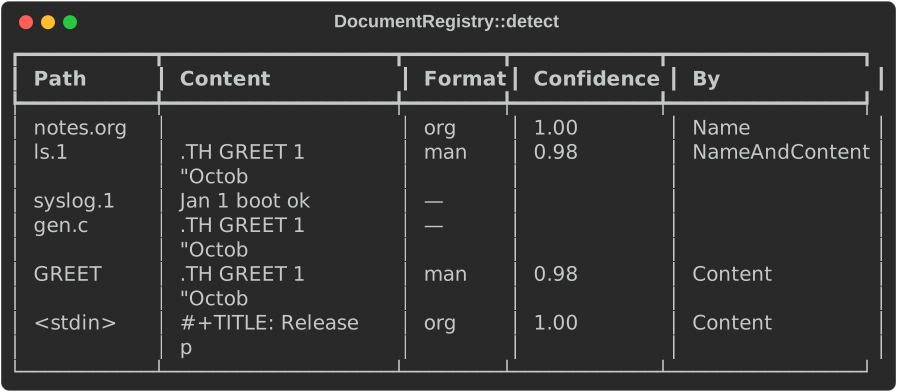
- A format's own extension wins:
.org,.adoc/.asciidoc,.rst,.md,.man/.roff/.mdoc. - An extension a format may use needs the content to agree, at
LIKELY(0.6) or above: a manual section (.1to.9, with a suffix such as.3pm) may be a rotated log, and.ascan armoured PGP file. - Any other extension is never a document:
gen.cstays C even when it quotes.TH. - With no extension (or no path), the content alone decides, when the most
confident format reaches the threshold you pass and leads the next by 0.1.
CERTAIN(0.9) is for input nobody asked about; Markdown and reStructuredText never reach it on content alone, as Markdown-like text is everywhere.
registry.sniff(text) lists every format's confidence, and each provider's
sniff reads at most the first 64 KiB.
Render by name, with diagnostics
fn show_registry(console: &Console) {
    let registry = DocumentRegistry::with_builtins();
    // Options apply to every format: links, code theme, the language of
    // unlabelled code, and fence renderers (Mermaid, DOT) for code blocks.
    let options = RenderOptions::new()
        .hyperlinks(false)
        .default_language("bash");
    let source = ".TH DEMO 1\n.SH EXAMPLE\n.EX\nrich ls.1 | less -R\n.EE\n.so other.1\n";
    let rendered = registry
        .render(source, "man", &options)
        .expect("a built-in");
    console.print(rendered.renderable.as_ref());
    for diagnostic in &rendered.diagnostics {
        if diagnostic.severity == Severity::Warning {
            console.print(&Text::styled(format!("warning: {diagnostic}"), "yellow"));
        }
    }
}
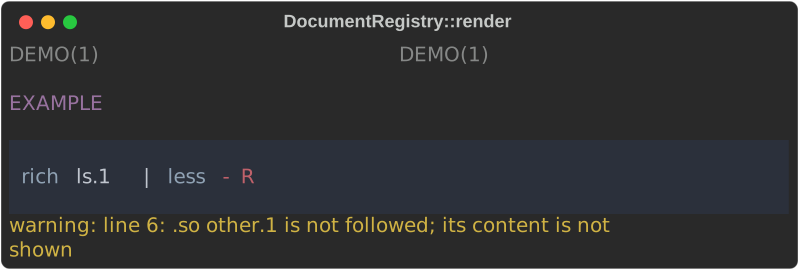
render returns the renderable and the Diagnostics: a Warning when
content is not shown as written (an include:: or .so not followed, an
equation, a block that never closes), an Info for what a terminal has no
use for (an export-only block, an unknown macro whose arguments are shown as
text). Each has the source line when it is known.
What each format covers
| Format | Drawn | Shown as text | Not shown |
|---|---|---|---|
| Org | headline tree with TODO keywords, priorities and tags; #+TITLE, #+SUBTITLE, #+AUTHOR, #+DATE; *bold*, /italic/, _underline_, =verbatim=, ~code~, +strike+; plain, numbered and description lists, checkboxes, [@N]; SRC, EXAMPLE, QUOTE, VERSE, CENTER blocks and NOTE-style special blocks; : fixed-width lines; tables with \|---\| rules and <l>/<c>/<r>; links and image links; drawers and planning lines; timestamps, footnotes, statistics cookies, entities |
macros ({{{name}}}), radio targets |
comments, COMMENT and EXPORT blocks, export snippets, #+NAME/#+ATTR_*, #+TBLFM; #+INCLUDE is not followed |
| AsciiDoc | header (title, author and revision lines, attributes), sections = to ======; constrained and unconstrained *strong*, _emphasis_, `mono`, #highlight#; {name} references; unordered, ordered, checklist, description and callout lists with + continuations; listing, source (with callouts), literal, example, sidebar, quote, verse and open blocks; block titles; admonitions; \|=== tables (implicit or %header header, cols alignment, cell styles) and ,===/:=== data tables; links, cross references, image::/image: placeholders, kbd:, btn:, menu:, footnotes, character references, typographic replacements |
other block and inline macros, as written; include:: (not followed, with a warning) |
comments, passthrough blocks, toc::[], page breaks; ifdef-style directives (their content is kept) |
| man | .TH header and footer; .SH, .SS; .PP/.P/.LP/.HP; .TP/.TQ, .IP; .RS/.RE; .B, .I, .SM, .SB and the alternating font macros; .nf/.fi, .EX/.EE; .br, .sp; .UR/.UE, .MT/.ME; .SY/.OP/.YS, .MR; font and special-character escapes, strings, .if/.ie/.el (as nroff evaluates them); tbl tables; the common mdoc macros (.Sh, .Nm, .Fl, .Ar, .Op, .Xr, .Bl/.It/.El, .Bd/.Ed, .Ex, .Rv, …) |
unknown macros' arguments | size, colour, motion and drawing escapes; .de/.ig bodies; eqn and pic blocks and .so (with a warning) |
Every parser is total: arbitrary input never panics, nesting is capped (16
levels of lists, 8 of blocks in blocks), and a megabyte of ordinary prose,
lists and headings renders in well under a second in a release build. Code
blocks and tables cost what Syntax and Table cost, as they do in
Markdown: a document made of nothing but code blocks is slower.
Build the model yourself
fn show_model(console: &Console) {
    // Any producer can build the shared model and draw it the same way.
    let document = Document {
        blocks: vec![
            Block::Paragraph(vec![
                Inline::text("Built by hand: "),
                Inline::Strong(vec![Inline::text("strong")]),
                Inline::text(", "),
                Inline::Code("code".into()),
                Inline::text(" and "),
                Inline::Link {
                    target: "https://example.com".into(),
                    content: vec![Inline::text("a link")],
                },
                Inline::text("."),
            ]),
            Block::Rule,
        ],
    };
    console.print(&DocumentView::new(document).hyperlinks(false));
}

document::model holds Block (headings, paragraphs, lists, definitions,
code, tables, quotes, admonitions, asides, indents, rules, images, properties,
banners, captions) and Inline (text, emphasis, strong, underline, strike,
code, links, images, line breaks, and Styled for a theme key).
Theme keys
The model reads the markdown.* keys for everything Markdown also draws, and
adds document.* keys (in extended_theme, and as fallbacks when a theme
lacks them): document.todo, document.done, document.priority,
document.tag, document.byline, document.caption, document.properties,
document.term, document.callout, document.checkbox.checked,
document.timestamp, document.mark, document.banner and the five
document.admonition.* kinds, among others (document::STYLES lists them).
Add a format
/// A format of your own: `.todo` files, one task per line.
struct TodoFormat;

impl DocumentFormat for TodoFormat {
    fn id(&self) -> &str {
        "todo"
    }

    fn name(&self) -> &str {
        "Task list"
    }

    fn extensions(&self) -> Vec<String> {
        vec!["todo".into()]
    }

    fn parse(&self, source: &str) -> Option<rich_ext::document::Parsed> {
        use rich_ext::document::model::{Checkbox, List, ListItem, ListKind};
        let items = source
            .lines()
            .filter(|line| !line.trim().is_empty())
            .map(|line| {
                let (done, text) = match line.strip_prefix("x ") {
                    Some(text) => (true, text),
                    None => (false, line),
                };
                ListItem {
                    checkbox: Some(if done {
                        Checkbox::Checked
                    } else {
                        Checkbox::Unchecked
                    }),
                    number: None,
                    blocks: vec![Block::Paragraph(vec![Inline::text(text)])],
                }
            })
            .collect();
        let list = Block::List(List {
            kind: ListKind::Bullet,
            items,
        });
        Some(rich_ext::document::Parsed {
            document: Document { blocks: vec![list] },
            diagnostics: Vec::new(),
        })
    }
}

fn show_custom(console: &Console) {
    let mut registry = DocumentRegistry::with_builtins();
    registry.register(Arc::new(TodoFormat)).expect("a new name");
    let found = registry
        .detect(Some("week.todo"), "", CERTAIN)
        .expect("by extension");
    let rendered = registry
        .render(
            "x Ship 0.0.19\nWrite the release notes\n",
            &found.format,
            &RenderOptions::new(),
        )
        .expect("registered");
    console.print(rendered.renderable.as_ref());
}

A format implements DocumentFormat: an id (a lowercase name, also usable as
a CLI value), aliases, extensions (or match_name for "maybe" extensions), a
sniff, and either parse (to draw through the shared model) or render.
A plugin cannot declare a document format through PluginRegistrar yet; it
can register a SourceRenderer, which a host wraps in a
SourceRendererFormat (adding the extensions it claims and a sniffer) to put
it in a registry. See Extending.
In the shell
rich notes.org, rich guide.adoc and rich ls.1 use this module, with
--org, --asciidoc and --man (and --format org, …) to choose a format
outright. The command-line guide
covers detection and the flags.
From Python
rs_rich.ext.document has the same formats: render(source, "org"),
detect, sniff and formats. See
Documents
in the Python docs.