Dependency graphs and JSON Schemas
Two sources the terminal is often asked about, drawn as trees (0.0.15):
Cargo's resolved dependency graph and JSON Schemas (and, since 0.0.16, SQL
DDL and Arrow schemas through the schema model); beside the graph, the
supply-chain reports (0.0.16) read feature,
build-time, advisory and licence data Cargo and its tools already wrote
(and, since 0.0.19, artifact sizes,
baselines, a licence policy
and SBOMs). Both live in rs-rich-ext
behind its data feature, as rich_ext::deps and rich_ext::schema; the
rich CLI shows them with rich deps and rich schema. Neither reads
colour alone: markers and words carry the meaning, and colour repeats it.
The examples below use the fixtures in crates/rich-ext/tests/fixtures/sources,
which CI renders on every change; fixture(name) reads one of them. The
snippets and pictures come from
guide_sources.rs
(and the SQL ones from rs-rich-data's
guide_schemas.rs):
A recording shows rich deps on the
same fixture in a terminal.
Cargo dependency graphs
DepGraph::from_json reads the output of cargo metadata --format-version 1:
every package, the workspace members, and which depend on which (normal,
build and dev). Running Cargo is the caller's business; the library only
reads its output.
fn dep_tree(console: &Console) -> Result {
    // The output of `cargo metadata --format-version 1`.
    let json = fixture("sources/cargo-metadata.json");
    let graph = DepGraph::from_json(&json)?;
    console.print(&DepTree::new(graph).summary(true));
    Ok(())
}
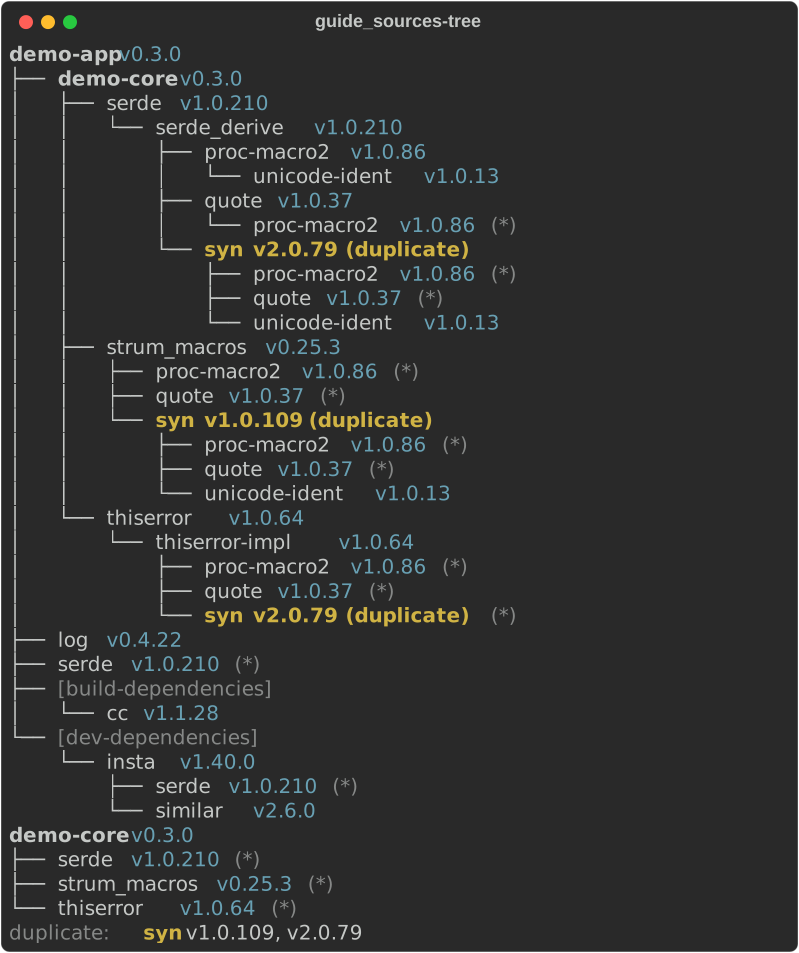
DepTree prints what cargo tree prints: each root (the package
cargo metadata ran in, else every workspace member) and what it depends on.
A package already shown is marked (*) instead of repeated, build and dev
dependencies sit under [build-dependencies] and [dev-dependencies], and a
crate resolved at more than one version is marked (duplicate) and coloured.
Dev dependencies are a root's only, as Cargo resolves them; a root is
expanded in full at the top level (its dev dependencies included) even when
it was already shown as another root's dependency, so demo-core above is
listed again with what it uses. max_depth, kinds and duplicates_only
trim it; summary(true) lists the duplicates underneath, counting only the
versions reachable through the kinds followed. A branch deeper than 128
levels (deps::MAX_TREE_DEPTH, far past any real graph) ends in a
… (deeper levels not shown …) note.
rich deps                         # runs cargo metadata in the working directory
rich deps path/to/Cargo.toml      # ... or for that manifest (or its directory)
rich deps --metadata meta.json    # ... or reads saved output (`-` for stdin)
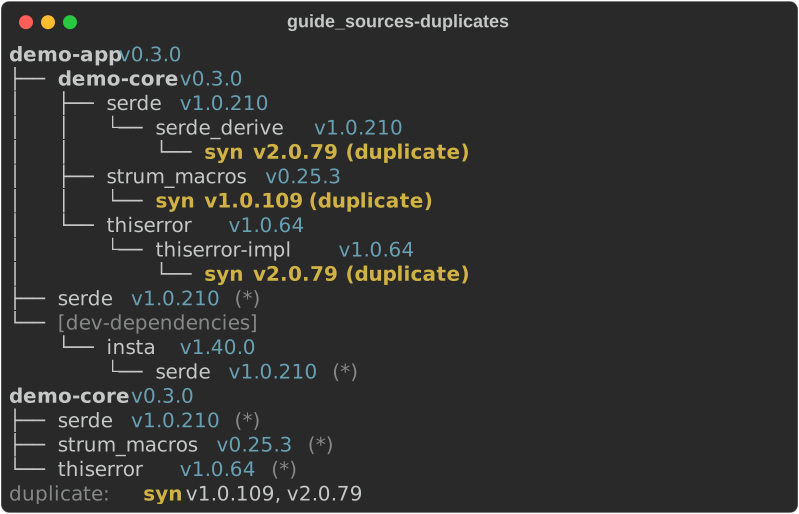
--depth N keeps N levels below each root, --no-dev leaves dev
dependencies out, and --duplicates keeps only the branches that lead to a
duplicated crate:
fn duplicates(console: &Console) -> Result {
    let graph = DepGraph::from_json(&fixture("sources/cargo-metadata.json"))?;
    console.print(&DepTree::new(graph).duplicates_only(true).summary(true));
    Ok(())
}
Running Cargo
Without --metadata, rich deps runs cargo metadata --format-version 1
($CARGO, else cargo on the PATH) in the working directory. Cargo runs
there with that directory's Cargo configuration: every
.cargo/config.toml from it up to the root, and the rust-toolchain.toml
rustup honours. cargo metadata compiles nothing, but it does run rustc
to learn the target, and it may fetch the registry index and git
dependencies as Cargo always does (rich deps does not pass --offline or
--locked; Cargo's own settings and CARGO_NET_OFFLINE apply).
A configuration can name programs. rich deps turns off the ones cargo
metadata would run without needing them: it sets RUSTC_WRAPPER,
CARGO_BUILD_RUSTC_WRAPPER, RUSTC_WORKSPACE_WRAPPER and
CARGO_BUILD_RUSTC_WORKSPACE_WRAPPER to empty for Cargo, which overrides a
build.rustc-wrapper or build.rustc-workspace-wrapper in the project's
configuration. What it cannot turn off is the rest of Cargo's behaviour: a
build.rustc naming another program still runs as the compiler, and a
rust-toolchain.toml still selects (and rustup may install) a toolchain.
Note that Cargo reads the configuration of the directory it is started in,
not the manifest's: rich deps path/to/Cargo.toml uses the working
directory's configuration (and that of the directories above it).
So in a checkout you do not trust, do not run rich deps there. Make the
metadata where running Cargo is safe (cargo metadata --format-version 1 >
meta.json, in a sandbox or a container) and read it with rich deps
--metadata meta.json, which runs nothing.
What pulls a crate in
--why CRATE (name, or name@version) prints WhyTree: the crate and
everything that depends on it, up to the workspace, which is every path that
pulls it in (what cargo tree -i prints). A dependent that uses it only as a
build or dev dependency is marked [build] or [dev]. DepGraph::paths_to
lists the paths one by one, shortest first.
fn why(console: &Console) -> Result {
let graph = DepGraph::from_json(&fixture("sources/cargo-metadata.json"))?;
console.print(&WhyTree::new(graph, "syn@1.0.109")?);
Ok(())
}

With --no-dev, a crate only dev dependencies pull in is not reached, and
rich deps --why says so and exits 4 rather than print nothing:
As a diagram
--graph draws the same through the diagram layout
instead: dependencies left to right, or for --why from the workspace down to
the crate. Workspace members are rounded, duplicated crates are hexagons, and
build and dev edges are dotted and labelled. A large graph is wider than the
terminal; --depth and -w help, and the drawing is cropped, never wrapped.
╭───────────────────╮
│ demo-core v0.3.0 │
╰─────────┬─────────╯
│
▼
┌───────────────────────┐
│ strum_macros v0.25.3 │
└───────────┬───────────┘
│
▼
╱───────────────╲
│ syn v1.0.109 │
╲───────────────╱
Supply-chain reports
Five reports sit beside the tree (0.0.16), in rich_ext::deps's submodules
duplicates, features, timings, audit and licenses. Each reads what
Cargo or its tools already wrote: cargo metadata, a cargo build
--timings report or cargo audit --json output. None runs a scanner or
reaches the network, and --timings and --audit do not run Cargo at all.
The examples use the fixtures in crates/rich-ext/tests/fixtures/supply-chain.
| Flag | Reads | Shows |
|---|---|---|
--duplicates |
cargo metadata |
the duplicated branches, then a consolidation summary |
--features [--package CRATE] |
cargo metadata |
each crate's enabled features, what they turn on, who asked |
--licenses |
cargo metadata |
crates grouped by licence; copyleft, unknown and missing marked |
--timings FILE |
cargo build --timings |
the slowest units as bars and a table |
--audit FILE |
cargo audit --json |
advisories grouped by severity; exit 5 on a vulnerability |
--sizes [DIR\|FILE] |
a target directory, or cargo bloat JSON |
artifact sizes per crate as bars and a table (0.0.19) |
--baseline FILE |
a saved report, or the original format | --timings or --sizes compared unit by unit; exit 5 on a regression (0.0.19) |
--policy FILE |
cargo metadata, or --sbom FILE |
licences checked against an allow and deny list, and conflicts; exit 5 on a violation (0.0.19) |
Four more modules back the 0.0.19 reports: sizes, compare, policy
and sbom, described below.
Give one report at a time. An option that does not apply to it (--graph,
--depth or --duplicates with any of them, --no-dev with anything but
--licenses, --metadata or a manifest with --timings and --audit) is
refused with exit 2 rather than ignored.
The parsers are bounded: --timings and --audit read at most 64 MiB
(deps::MAX_INPUT), every reader takes at most 100,000 packages, units or
advisories (deps::MAX_RECORDS), JSON nests at most 128 levels (serde_json's
limit), and a licence expression is at most 1,024 bytes and 32 parentheses
deep. Past a limit, or on malformed input, the reader returns an error, and
rich deps exits 4 naming it.
Consolidating duplicates
--duplicates keeps only the branches that lead to a duplicated crate, as
before, and now adds Consolidation under the tree: for each crate resolved
at more than one version, every version with what depends on it, and the
version most dependents already use (the newest by SemVer, on a tie). It does
not say the others could move onto it: that depends on their version
requirements, which the resolved graph does not record. DepGraph::consolidation(kinds) returns the same as data
(Duplicate::shared_version, Duplicate::to_move), and
DepTree::consolidation(true) adds it under a tree. Without --duplicates,
rich deps prints what it always did.
fn consolidation(console: &Console) -> Result {
    let graph = DepGraph::from_json(&fixture("supply-chain/cargo-metadata.json"))?;
    // What `--duplicates` adds under the tree; `DepTree::consolidation(true)`
    // puts it there.
    console.print(&Consolidation::new(&graph));
    Ok(())
}

Feature trees
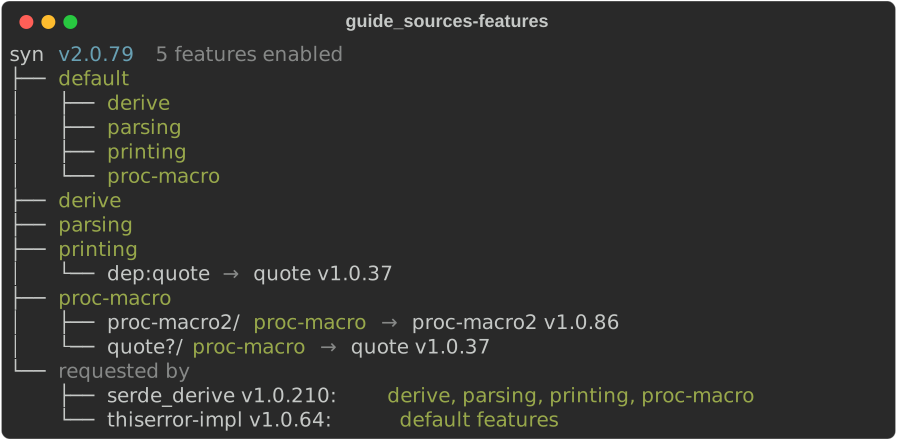
--features reads the features Cargo resolved (resolve.nodes[].features,
unified across the build), each package's [features] table and the
features its dependents ask for. FeatureTree draws a crate: each enabled
feature with its definition underneath (another feature, an optional
dependency dep:name and the package it resolved to, or a dependency's
feature name/feature, with name?/feature applying only when that
dependency is on for another reason), and under "requested by" each
dependent with the features its manifest names and the features of its own
that turn on more. An entry Cargo did not act on is marked (off).
Without --package, every crate with a feature enabled is shown, the
workspace members first, and the rest are counted.
fn features(console: &Console) -> Result {
    let graph = FeatureGraph::from_json(&fixture("supply-chain/cargo-metadata.json"))?;
    console.print(&FeatureTree::new(graph, Some("syn@2.0.79"))?);
    Ok(())
}
Build times
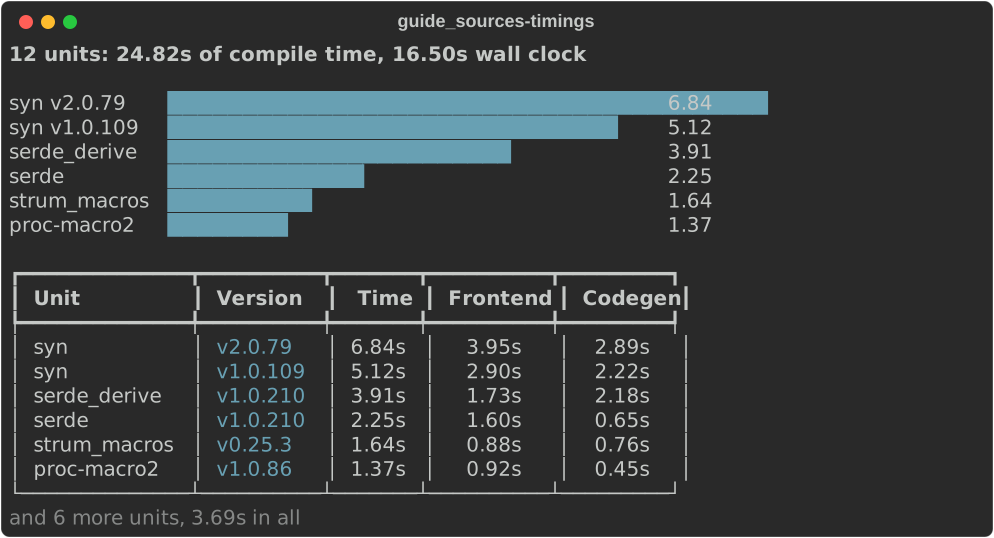
--timings FILE reads the report cargo build --timings writes to
target/cargo-timings/cargo-timing.html (its script holds every unit as
JSON), that UNIT_DATA array on its own, or the timing-info JSON lines
older nightly toolchains wrote with --timings=json -Zunstable-options.
TimingsReport shows the totals, the 20 slowest units as bars
(TimingsReport::limit changes the number) and a table that splits each
unit's time into the frontend (until its .rmeta was ready, which lets
dependents start) and codegen. A crate built at two versions has the version
in its bar's label. Artifact sizes are not in the report: --sizes shows them
(below).
fn timings(console: &Console) -> Result {
    // target/cargo-timings/cargo-timing.html, from `cargo build --timings`.
    let timings = Timings::parse(&fixture("supply-chain/cargo-timing.html"))?;
    console.print(&TimingsReport::new(timings).limit(6));
    Ok(())
}
Advisories
audit::Advisory is a generic model of one finding: id, kind
(vulnerability, unsound, unmaintained, yanked or notice), package and the
version in use, the patched and unaffected version requirements, severity
and CVSS score, title, link, aliases and date. AdvisoryReport::from_cargo_audit
reads cargo audit --json; a plugin reading another scanner builds the same
values and passes them to AdvisoryReport::new. cargo audit gives a CVSS
vector rather than a severity: a CVSS 3.x vector is scored with the
specification's formula (audit::cvss3_score) and banded as CVSS does; a
vulnerability without one (or with a CVSS 4 vector) is unknown, and a
warning without one is informational.
The report lists the counts, then a table grouped by severity, most severe first. The ID links to the advisory in a terminal that shows links.
fn audit(console: &Console) -> Result {
    // `cargo audit --json > audit.json`
    let report = AdvisoryReport::from_cargo_audit(&fixture("supply-chain/cargo-audit.json"))?;
    console.print(&report);
    Ok(())
}
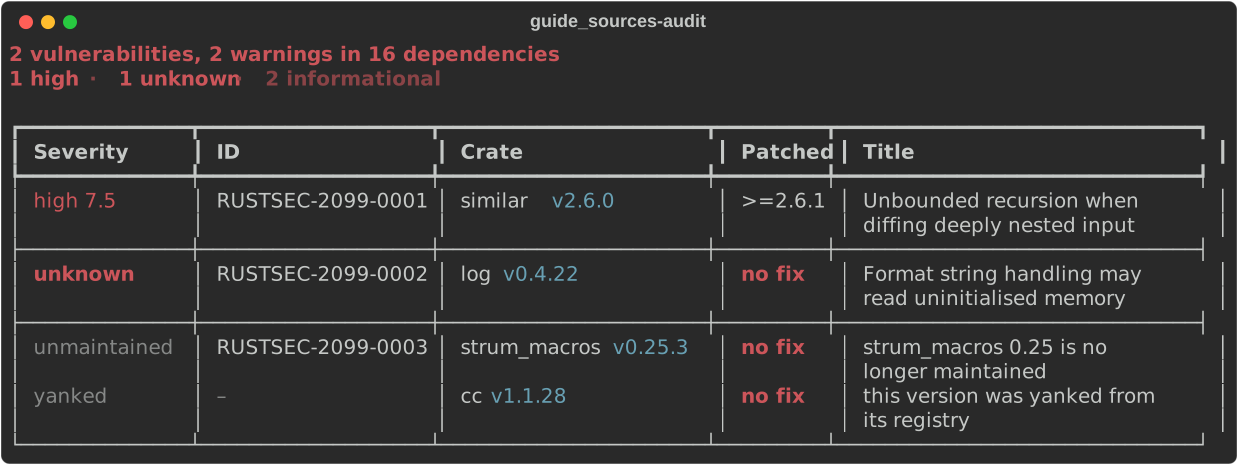
rich deps --audit then ends with rich: 2 vulnerabilities found:
RUSTSEC-2099-0001, RUSTSEC-2099-0002 on stderr.
Exit code. Like cargo audit itself, and like the CLI's other gates
(diff --threshold, bench compare), rich deps --audit exits 5 when the
report lists a vulnerability, after showing it in full; with --report json
the one envelope on stderr has "code": "gate". Warnings alone (unmaintained,
unsound, yanked) exit 0. A file that is not cargo audit JSON exits 4.
Licences
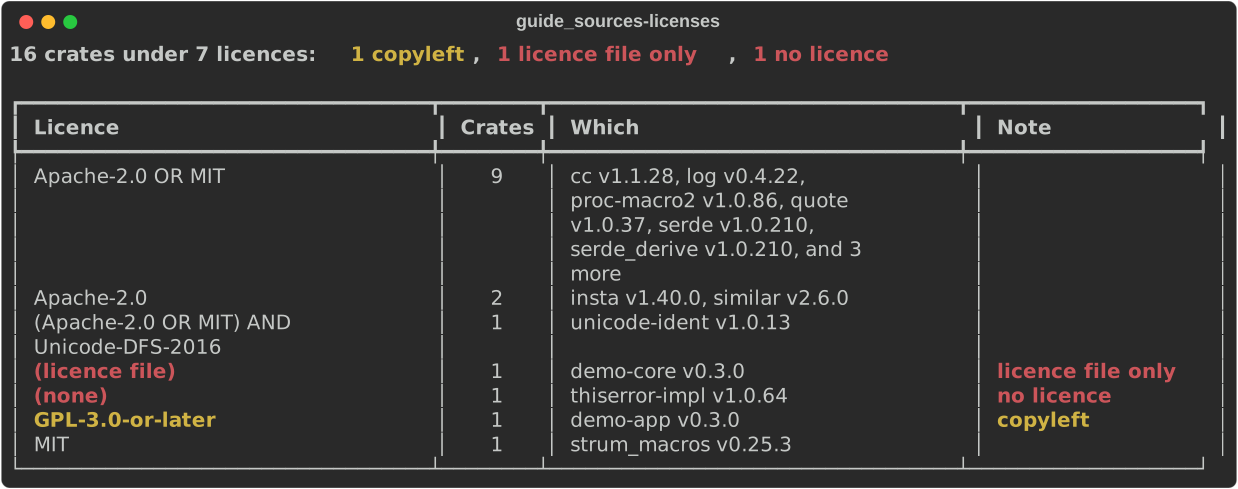
--licenses groups the packages the tree reaches (--no-dev leaves out
those only dev dependencies pull in) by their license expression, or notes
a license-file or no licence at all. licenses::classify reads SPDX
expressions (AND, OR, WITH, parentheses, and the old MIT/Apache-2.0
form): an OR is as permissive as its most permissive choice, an AND as
strict as its strictest part. Weak copyleft (LGPL, MPL, EPL, CDDL, …),
copyleft (GPL, AGPL, EUPL, OSL, SSPL, CC-BY-SA), unknown identifiers,
unreadable expressions, licence files and missing licences are marked; the
operands of an expression are sorted, so MIT OR Apache-2.0 and
Apache-2.0 OR MIT are one group. It is a reading aid, not legal advice.
fn licenses(console: &Console) -> Result {
    let report = LicenseReport::from_json(&fixture("supply-chain/cargo-metadata.json"))?;
    console.print(&report);
    Ok(())
}
Artifact sizes
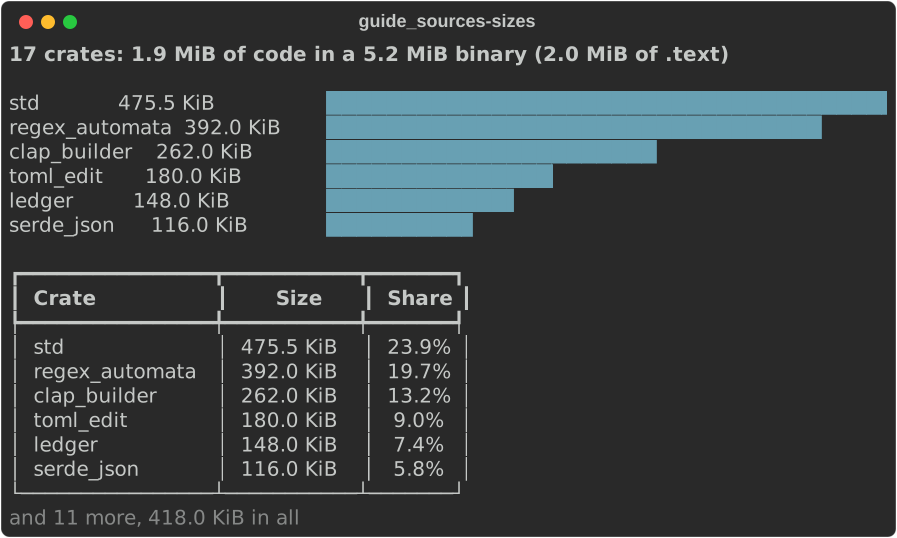
sizes::Sizes measures what each crate adds to a build (0.0.19). Two
sources feed it:
- A target directory.
Sizes::from_target_dir(dir, metadata, options)reads one profile's directory (target/debug,target/release, a cross build'starget/<triple>/<profile>, or that directory itself) and matches each artifact to a package incargo metadata: libraries indeps/(the.rlib, else the.rmetaa check build leaves), proc-macros and dylibs (.so,.dylib,.dll), static libraries, and the workspace's binaries. When a crate is resolved at two versions, its dep-info file says which package an artifact belongs to. Old builds leave artifacts behind, so of each package's artifacts of a kind the newest is taken; artifacts no package claims are counted, not shown.SizeOptions::profilepicks the profile (devandtestbuild intodebug,benchintorelease);SizeOptions::sourcesadds each package's source size (its manifest directory, withouttarget/,.git/and nested packages, never following a symbolic link). - cargo-bloat.
Sizes::parsereadscargo bloat --crates --message-format json(or its per-function listing, added up by crate): each crate's share of one binary's code.
SizeReport draws the total, the largest entries as bars and a table with
each one's share; SizeReport::limit sets how many (20 by default).
rich deps --sizes                          # the target directory cargo metadata names
rich deps --sizes target --build-profile release --source-sizes
cargo bloat --release --crates --message-format json > bloat.json
rich deps --sizes bloat.json --top 6
fn sizes(console: &Console) -> Result {
    // `cargo bloat --crates --message-format json > bloat.json`; a target
    // directory reads with `Sizes::from_target_dir(dir, metadata, options)`.
    let sizes = Sizes::parse(&fixture("deps/bloat.json"))?;
    console.print(&SizeReport::new(sizes).limit(6));
    Ok(())
}
Comparing with a baseline
compare::Comparison sets two timings or size reports side by side, unit
by unit: a timing unit by its label (syn, app build-script (run)), a
size entry by its crate (app (bin) for a binary). A name that appears
twice on one side, a crate built at two versions, is added up, so dropping
a duplicate reads as a smaller unit. Each unit gets a verdict:
- regression: it grew by more than the percentage and by more than the absolute floor. A new unit regresses when it is larger than the floor.
- improvement: it shrank by both.
- new (no larger than the floor), removed, or unchanged.
The floor keeps noise on small units from counting. Thresholds::TIMINGS
is 10% and 0.5 s, Thresholds::SIZES 10% and 64 KiB;
Threshold::parse("100KiB") and Thresholds::with change either. The
totals are compared the same way. Comparison::regressions() lists the
units that regressed, and Comparison::failed() adds the total, for a gate.
Timings::to_json and Sizes::to_json save a report as JSON, and
Timings::parse and Sizes::parse read it back, so CI can keep one build's
report and compare the next with it:
rich deps --sizes bloat.json --save sizes.json          # keep it
rich deps --sizes bloat.json --baseline sizes.json      # later: compare
rich deps --timings target/cargo-timings/cargo-timing.html \
  --baseline timings.json --threshold 15% --threshold 1s
fn comparison(console: &Console) -> Result {
    // A baseline kept from an earlier build (`Sizes::to_json` saves one).
    let old = Sizes::parse(&fixture("deps/bloat-baseline.json"))?;
    let new = Sizes::parse(&fixture("deps/bloat.json"))?;
    let comparison = Comparison::sizes(&old, &new, Thresholds::SIZES)
        .names("bloat-baseline.json", "bloat.json")
        .limit(6);
    let regressed: Vec<&str> = comparison
        .regressions()
        .iter()
        .map(|row| row.key.as_str())
        .collect();
    assert_eq!(regressed, ["toml_edit", "regex_automata"]);
    console.print(&comparison);
    Ok(())
}
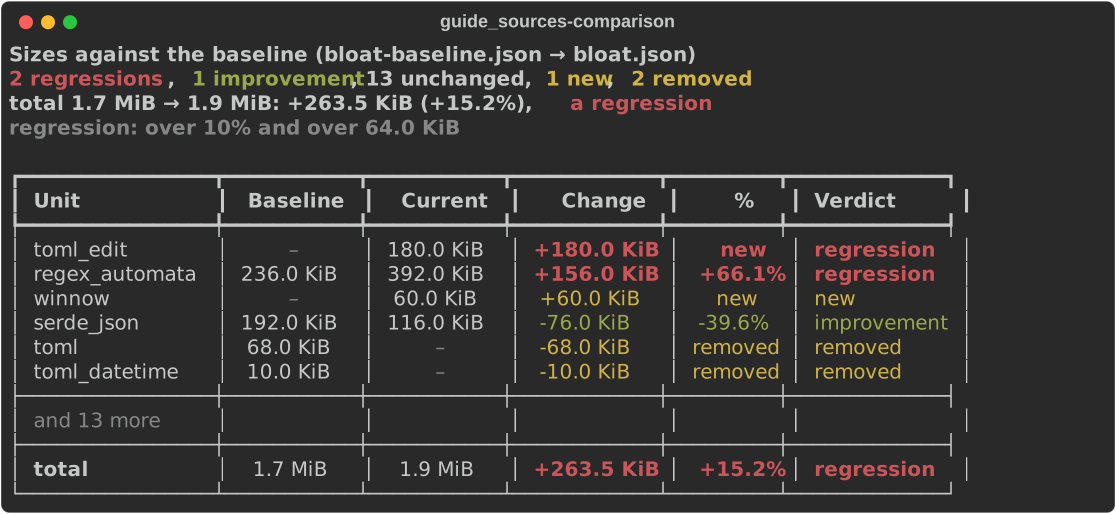
rich deps --baseline exits 5 when a unit or the total regressed, like
--audit, naming them on stderr: rich: 3 regressions against the
baseline (over 10% and over 64.0 KiB): toml_edit, regex_automata, the
total. --threshold takes a percentage (10%, or a bare 10), a time
(0.5s, 500ms) for --timings or a size (100KiB, 1MB, 512B) for
--sizes; give it twice to set both. --threshold 0B (or 0s) drops the
floor.
Licence policy
policy::Policy is an allow and deny list (0.0.19). Policy::from_toml
(with the toml feature) reads either shape, told apart by whether the
document has a [licenses] table:
# A licence policy for `rich deps --policy policy.toml`.
#
# Licences any crate may use. Each crate's licence expression is evaluated:
# `MIT OR GPL-3.0-only` passes, because MIT is allowed.
allow = [
    "MIT",
    "Apache-2.0",
    "Apache-2.0 WITH LLVM-exception",
    "BSD-3-Clause",
    "ISC",
    "Unicode-DFS-2016",
    "Unicode-3.0",
    "MPL-2.0",
]

# Refused whatever the allow list says, however suffixed (-only, -or-later).
deny = ["GPL-3.0", "AGPL-3.0"]

# One crate may use more.
exceptions = [
    { name = "acme-telemetry", allow = ["LicenseRef-Acme-EULA"] },
]

# Licences that conflict with the root crate's: "warn" (shown), "deny"
# (they fail the check too) or "ignore".
conflicts = "warn"
or cargo-deny's deny.toml, of which it reads [licenses]: allow,
deny (older releases), exceptions (crate or name, an optional
version requirement, allow) and private.ignore (with cargo metadata,
the workspace's unpublished crates are left out). It notes the keys it does
not apply, such as confidence-threshold and clarify: licence files are
not read. In cargo-deny's shape a licence not allowed is refused, as
cargo-deny refuses it; in rich's, a policy without allow allows whatever
it does not deny.
Each expression is evaluated, not matched as text. An OR passes when any
alternative is allowed (MIT OR GPL-3.0-only passes on MIT), an AND when
every part is, and a WITH exception belongs to the licence:
Apache-2.0 WITH LLVM-exception must be allowed as written. Identifiers
match without case, and -only, -or-later and + are read, so allowing
GPL-3.0-only satisfies GPL-2.0-or-later. A deny entry catches its
licence however it is suffixed (and with any exception, unless the entry
names one), and wins over the allow list; a crate's exception wins over
both. A crate with no licence, only a licence file, or an expression that
does not parse is a violation under an allow list and a warning without
one.
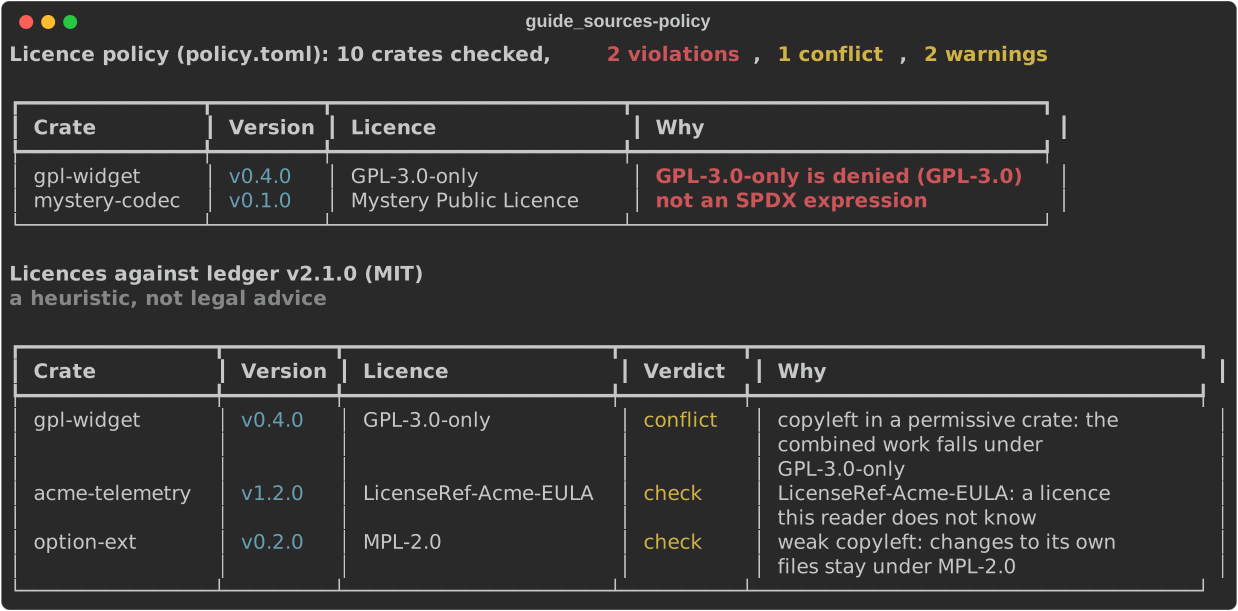
Conflicts. policy::conflicts(root, packages) sets each dependency's
licence against the root crate's on a small table. It is a heuristic, not
legal advice:
| Dependency | Root permissive, proprietary or unlicensed | Root weak copyleft | Root strong copyleft |
|---|---|---|---|
| Permissive | fine | fine | fine (but Apache-2.0 under GPL-2.0-only conflicts) |
| Weak copyleft (LGPL, MPL, EPL, …) | check | fine | fine (but EPL-1.0 and CDDL conflict with the GPL, and version 3 licences with GPL-2.0-only) |
| Strong copyleft (GPL, AGPL, EUPL, …) | conflict | conflict | fine within the GNU family (but version 3 under GPL-2.0-only conflicts, and AGPL under GPL is a check); another family is a check |
| Unknown identifier | check | check | check |
An OR takes its best alternative and an AND its worst part, on either
side. A linking exception (Classpath, the GCC runtime library, LLVM) makes
a copyleft licence count as weak. rich deps --policy checks each
workspace member against what it ships with: its normal dependencies, all
the way down (dev and build dependencies are not part of what it builds).
A policy's conflicts = "warn" (the default) shows them, "deny" makes a
conflict fail the check, and "ignore" leaves them out.
PolicyReport draws the violations (crate, version, expression, why), the
conflicts and the warnings; PolicyReport::failed() says whether the check
failed, which rich deps --policy turns into exit 5.
fn policy(console: &Console) -> Result {
    // rich's policy TOML, or cargo-deny's deny.toml.
    let policy = Policy::from_toml(&fixture("deps/policy.toml"))?;
    // The packages of a CycloneDX document; `LicenseReport::from_json` reads
    // `cargo metadata` instead.
    let sbom = Sbom::parse(&fixture("deps/sbom.cdx.json"))?;
    let mut report = PolicyReport::new(sbom.report(), &policy).named("policy.toml");
    if let Some(root) = sbom.root() {
        report = report.root(root);
    }
    console.print(&report);
    Ok(())
}
SBOMs
sbom::Sbom::parse reads an SPDX (2.2, 2.3) or CycloneDX (1.4 to 1.6) JSON
document, told apart by content, into the same LicenseReport, so the
licence report and the policy work beyond Cargo. From SPDX it takes each
package's licenseConcluded, else licenseDeclared (NOASSERTION and
NONE read as no licence), and the package the document DESCRIBES as
the root; from CycloneDX each component's (nested ones too) licenses, an
expression or a license id or name, several of them read as all
applying (AND, the stricter reading), and metadata.component as the
root. SPDX tag-value, SPDX 3 and XML documents are refused with an error
that names them.
JSON Schema
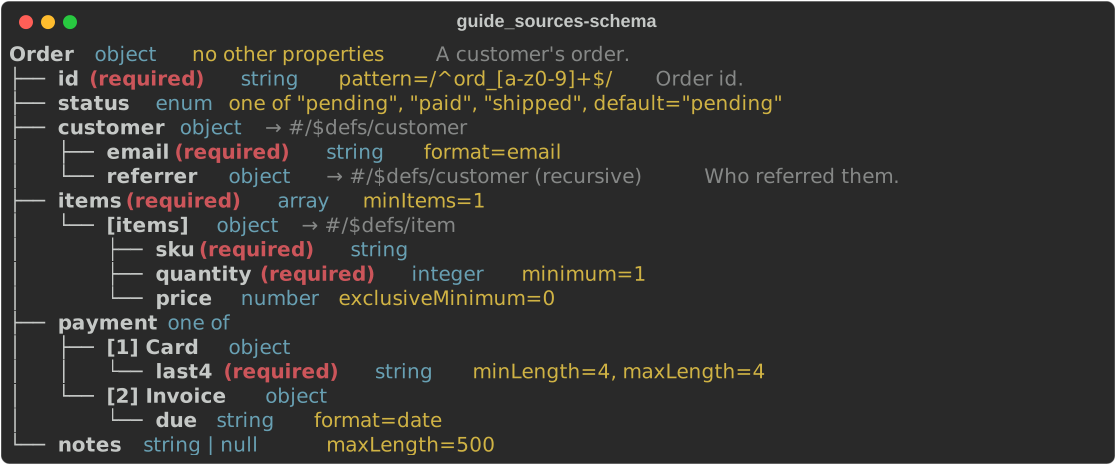
SchemaTree draws a schema as a tree of its properties: each with its type, a
(required) marker, its constraints (minLength=1, format=email,
one of "a", "b", no other properties, …) and the first line of its
description. Array items ([items], or [0], [1] for tuples),
patternProperties (/pattern/), additionalProperties
([other properties]), oneOf / anyOf / allOf branches, not and
if / then / else are branches of their own.
A $ref within the document (#/$defs/…, #/definitions/…, any JSON
pointer, or a $anchor) is resolved and drawn in place, marked → #/$defs/…;
one that refers back to a schema it is already inside (however the reference
is spelled: #/%24defs/x is #/$defs/x) is marked (recursive) instead of
drawn again, and one to another document is shown, not fetched. A definition
shared through $refs is drawn wherever it is used, which a small schema can
make exponentially many places: the tree stops at 10,000 entries
(schema::MAX_ENTRIES) and ends with a … (the tree stops at 10000
entries) note.
fn schema_tree(console: &Console) -> Result {
    let json = fixture("sources/order-v1.schema.json");
    console.print(&SchemaTree::from_json(&json)?);
    Ok(())
}
What changed
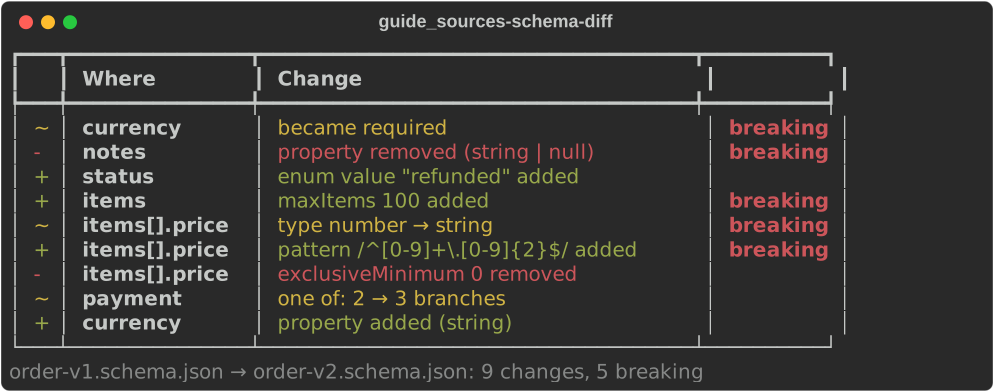
SchemaDiff::new(&old, &new) compares two versions: properties added and
removed, type changes, properties that became (or stopped being) required,
enum values, constraints and branch counts, each marked +, - or ~.
breaking marks a change that may refuse a document the old version
accepted: a new requirement, a removed enum value, a narrower type, a tighter
bound, or a removed property the new version may refuse (through
additionalProperties: false or a schema, or a patternProperties schema it
matches; true, {} or no additionalProperties still accepts it). Keywords
beside a local $ref are compared along with the schema it names. Shared
definitions are compared wherever they are used, so the diff has a budget
too: it stops after 10,000 changes (schema::MAX_CHANGES) or 100,000
comparisons of differing schemas (MAX_COMPARISONS), and then says so in its
summary ((stopped after …: more may differ); SchemaDiff::is_truncated).
rich schema OLD NEW prints it:
fn schema_diff(console: &Console) -> Result {
    let old = schema::parse(&fixture("sources/order-v1.schema.json"))?;
    let new = schema::parse(&fixture("sources/order-v2.schema.json"))?;
    let diff = SchemaDiff::new(&old, &new).names("order-v1.schema.json", "order-v2.schema.json");
    console.print(&diff);
    Ok(())
}
Both read a file, an http(s) URL or - (stdin, for one of the two); a file
that is not a JSON Schema (an object, true or false) is an error, exit 4.
The schema model
SchemaTree and SchemaDiff read a format-neutral model,
rich_ext::schema::{Schema, Field, DataType, Constraint} (0.0.16), so JSON
Schema, SQL DDL and Arrow schemas draw and compare the same way. A Schema
is a list of Fields, optionally named, and (for a SQL file) further named
tables. A field has a model type (integer, decimal(10,2),
timestamp[UTC], list<…>, struct, map<…, …>), the source's own type
name as written (VARCHAR(255), Int32, string | null), which the tree
shows, whether it may be null and whether a value must be present, and its
constraints: enum values, bounds, length, pattern, format, a default, primary
and unique keys and a ForeignKey to table.column. A key across several
columns is the table's own constraint.
schema::json::to_model maps a JSON Schema into the model; SchemaTree::new
draws a JSON Schema through the same mapping, and the output above is byte
for byte what it was before the model existed. JSON Schema's own structure
(pattern-named properties, tuple items, oneOf branches, $refs) is kept
with each child's FieldKind and the reference its type came through.
SQL DDL
schema::sql::parse reads a small CREATE TABLE subset: column names and
types (quoted or not, with parameters, several words such as
DOUBLE PRECISION, and arrays), NOT NULL, DEFAULT, PRIMARY KEY,
UNIQUE and REFERENCES on a column or for several columns on the table,
CONSTRAINT name, MySQL's ENUM(…) and COMMENT, -- and /* */
comments, PostgreSQL's $$ … $$ strings, and any number of statements.
CHECK constraints, indexes and every statement but CREATE TABLE are
skipped, each with a note giving its line; text it cannot read (an unclosed
string or parenthesis, a table with no column list) is an error with its
line. Input is bounded: 16 MiB, 100,000 statements, 1,000,000 tokens a
statement, 4,096 columns a table or a key and parentheses 64 deep;
statements are read one at a time.
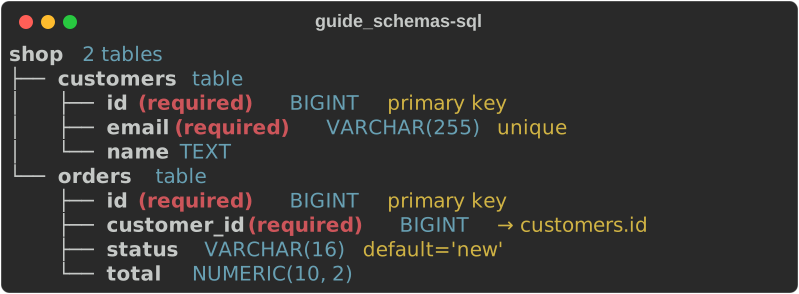
fn sql_tree(console: &Console) -> Result {
    let parsed = sql::parse(V1)?;
    for note in &parsed.notes {
        eprintln!("{note}"); // line 13: orders.total: CHECK constraint skipped
    }
    console.print(&SchemaTree::from_model(parsed.schema).title("shop"));
    Ok(())
}
V1 and V2 are two versions of a shop's DDL:
The DDL
const V1: &str = "
-- The shop, version 1.
CREATE TABLE customers (
    id      BIGINT PRIMARY KEY,
    email   VARCHAR(255) NOT NULL UNIQUE,
    name    TEXT
);

CREATE TABLE orders (
    id          BIGINT PRIMARY KEY,
    customer_id BIGINT NOT NULL REFERENCES customers (id),
    status      VARCHAR(16) DEFAULT 'new',
    total       NUMERIC(10, 2) CHECK (total >= 0)
);
";

const V2: &str = "
CREATE TABLE customers (
    id      BIGINT PRIMARY KEY,
    email   VARCHAR(320) NOT NULL UNIQUE,
    name    TEXT NOT NULL
);

CREATE TABLE orders (
    id          BIGINT PRIMARY KEY,
    customer_id BIGINT NOT NULL REFERENCES customers (id),
    status      VARCHAR(16) DEFAULT 'pending',
    total       NUMERIC(12, 2),
    placed_at   TIMESTAMP WITH TIME ZONE
);

CREATE TABLE order_lines (
    order_id BIGINT REFERENCES orders (id),
    line     INT,
    sku      TEXT NOT NULL,
    PRIMARY KEY (order_id, line)
);
";
Comparing any two schemas
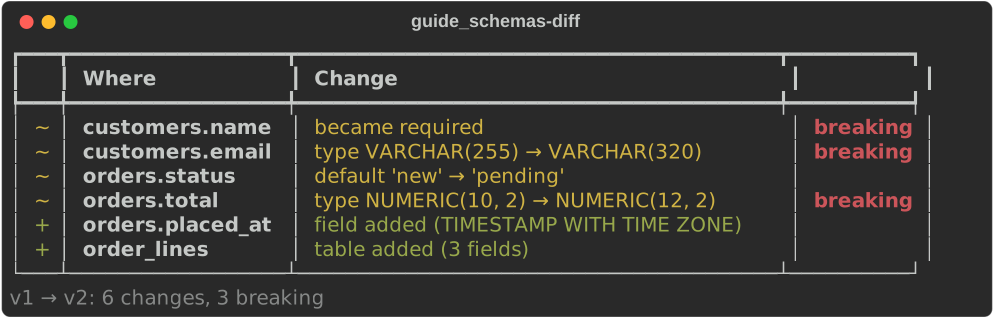
SchemaDiff::models(&old, &new) compares two model schemas: fields by name
(nested ones by path, a list's items as field[]), then tables by name. It
reports the same kinds of change as the JSON Schema diff, plus keys and
metadata, with the same breaking rule: a new requirement (a NOT NULL, a
non-nullable Arrow field), a field no longer nullable, a changed type, a new key or reference, a tighter
bound, a removed enum value, and a removed field or table (rows that have it
no longer fit). A changed default or metadata entry is informational. Types
are compared by the source's own name, ignoring case, so INT → BIGINT and
Int32 → Int64 are changes; comparing schemas from two formats works, but
reports every type whose names differ.
fn diff(console: &Console) -> Result {
    let v1 = sql::parse(V1)?.schema;
    let v2 = sql::parse(V2)?.schema;
    console.print(&SchemaDiff::models(&v1, &v2).names("v1", "v2"));
    Ok(())
}
SchemaDiff::new stays the way to compare two JSON Schemas: it follows
$refs as it goes, so shared definitions are compared only where they
differ.
Arrow schemas
With rs-rich-data's arrow feature, rich_data::arrow::schema maps an
Arrow schema into the model: nested structs, lists and maps, dictionaries
(as their value type), timestamps with their unit and time zone, decimals
with precision and scale, nullability, and field and schema metadata.
arrow::tree draws it and arrow::diff compares two (#342):
events  8 fields  version=1
├── id (required)  Int32
├── at (required)  Timestamp(µs, "Europe/Paris")
├── kind  Dictionary(Int8, Utf8)  description=kind
├── amount  Decimal128(12, 2)
├── tags  List
│   └── item  Utf8
├── address  Struct
│   ├── city (required)  Utf8
│   └── zip  Utf8
├── scores  Map
│   ├── key (required)  Utf8
│   └── value  Float64
└── debug  Boolean
Schema evolution
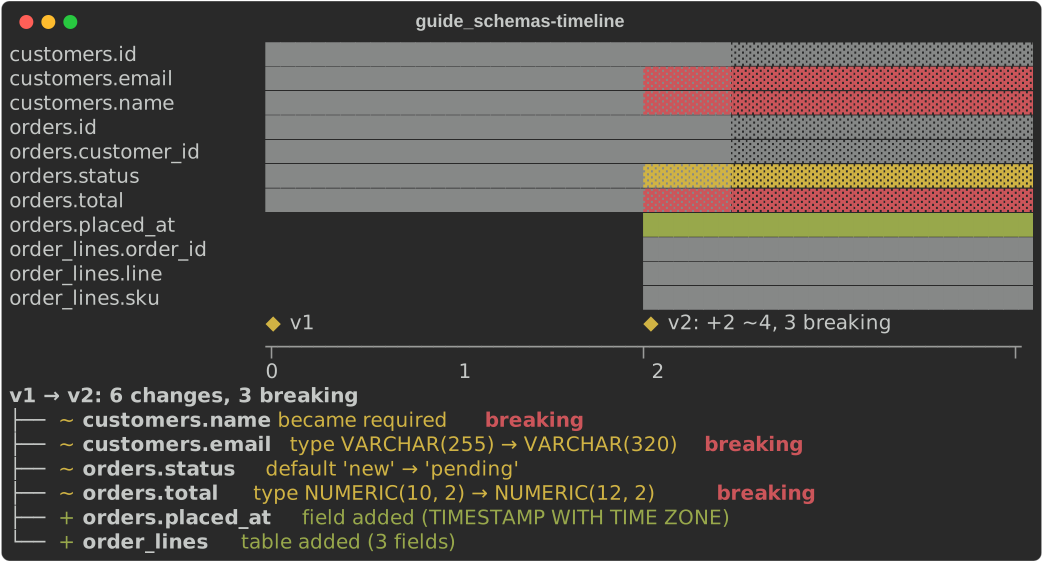
SchemaTimeline lays a series of versions on a chart::Timeline (#347): a
row per field (table.column for DDL) spanning the versions it is in, a
milestone per version with its counts (v2: +2 ~4, 3 breaking), and, unless
details(false), every change listed under it. A span takes the added,
changed or breaking style in the version its field changed. Versions are at
their index unless placed with at; consecutive JSON Schemas compare as
JSON Schema, anything else through the model.
fn timeline(console: &Console) -> Result {
    let timeline = SchemaTimeline::new()
        .push("v1", sql::parse(V1)?.schema)
        .push("v2", sql::parse(V2)?.schema);
    console.print(&timeline);
    Ok(())
}
From the command line, rich schema reads JSON Schema, SQL DDL (.sql,
.ddl) and Arrow IPC files (with the CLI's arrow feature), compares any two,
and draws an ER diagram with --er; see the CLI docs.
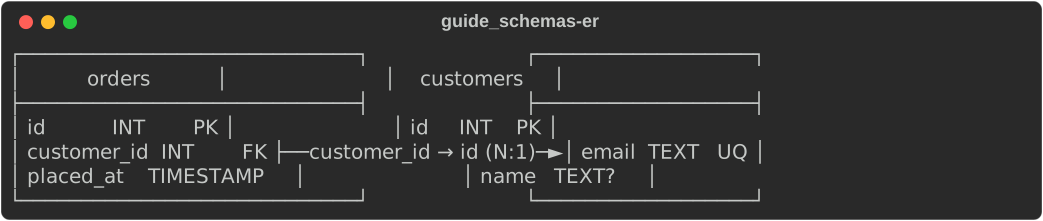
ER diagrams
rs-rich-data's er module (behind its er feature) draws a schema as an
ER diagram through rs-rich-diagram (#247): a box per table with its
columns, types and keys (PK, FK, UQ, ? for nullable), and an edge
per foreign key, N:1, or 1:1 when the key is the referring table's whole
primary key or a unique column. er::model turns any model schema into an
ErModel; er::from_sql reads DDL and returns the ErDiagram with the
reader's notes. A key naming users finds public.users when that is the
only table so named.
const DDL: &str = "
CREATE TABLE customers (id INT PRIMARY KEY, email TEXT NOT NULL UNIQUE, name TEXT);
CREATE TABLE orders (
    id          INT PRIMARY KEY,
    customer_id INT NOT NULL REFERENCES customers (id),
    placed_at   TIMESTAMP NOT NULL
);
";

fn er_diagram(console: &Console) -> Result {
    let (diagram, notes) = er::from_sql(DDL)?;
    assert!(notes.is_empty());
    console.print(&diagram);
    Ok(())
}