Inspect¶
Python's rich.inspect
prints a report on any object: its type, docstring, value and attributes,
and with methods=True its methods. rs-rich-ext has the same report for
Rust values, laid out the same way.
Python finds what to show at run time, with dir() and getattr(). Rust
has no runtime reflection, so #[derive(Inspect)] collects it at compile
time instead: the type's name and doc comment, each field's name, type,
doc comment, visibility and value, and an enum's variants.
#[inspect] on an impl block records its methods.
The report itself (rich_ext::inspect) needs no feature; only the derive
and #[inspect] do. A hand-written Inspectable impl works without them.
Deriving it¶
/// A point in the plane.
///
/// Only `help` shows this paragraph.
#[derive(Inspect)]
#[inspect(methods)] // list the methods `#[inspect]` records below
pub struct Point {
    pub x: i32,
    pub y: f64,
    pub label: String,
    secret: u8, // private: shown with `private`
}

#[inspect]
impl Point {
    /// The length, scaled.
    pub fn norm(&self, scale: f64) -> f64 {
        f64::from(self.x).hypot(self.y) * scale
    }
}
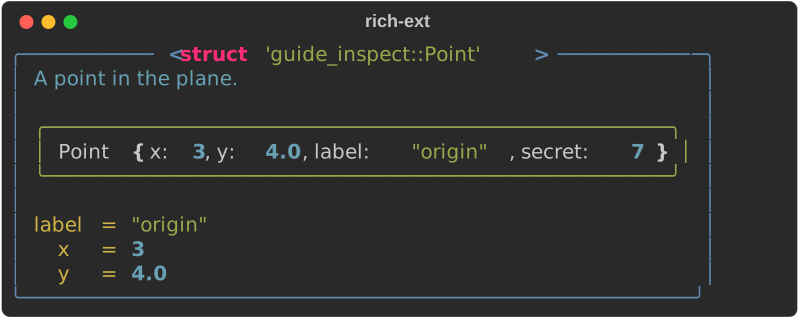
The panel is upstream's: a blue scope.border panel fitted to its
contents, titled with the type; the doc comment's first paragraph in
inspect.help; the value in a green inspect.value.border panel; and a
grid of name = value rows with the names right-aligned. Values are their
Debug output, on one line where it fits and expanded ({:#?}) where it
does not. Private (non-pub) fields are hidden, as Python hides _names,
but the value panel shows every field, as Python's repr does.
Options¶
Inspect::new(&value) takes upstream's options as builder methods;
InspectOptions holds the same ones for inspect() and rich_inspect!.
| option | default | what it does |
|---|---|---|
methods |
off | list the methods #[inspect] recorded |
docs |
on | show doc comments: the type's, each field's and each method's |
help |
off | full doc comments, not only their first paragraph |
private |
off | show non-pub fields and methods |
sort |
on | sort fields and methods by name; off keeps declaration order |
value |
on | show the value in a panel |
types |
off | show each field's type as written: x: i32 = 3 |
variants |
off | for an enum, list every variant |
all |
— | turn on methods, private, types and variants |
title |
the type | the panel's title (console markup) |
label |
none | the expression's source text, before the type |
max_depth |
3 | how deep #[inspect(nested)] reports go |
Methods¶
Methods can't be found generically: a type's inherent methods are not
visible to a derive on the type. So a method list needs two marks: put
#[inspect] on the impl block, and #[inspect(methods)] on the type.
Each method's row is its signature as written (pub fn, const, async,
unsafe and extern included), then its doc comment. A non-pub method
shows only with private, and #[inspect(skip)] on a method leaves it
out. One impl block per type can carry #[inspect]; a trait impl cannot.
#[inspect] is rich_ext::inspect; write it with the path
(#[rich_ext::inspect]) if you don't import it.
Fields that aren't Debug, enums, generics and nesting¶
/// A request, as a server sees it.
#[derive(Inspect)]
pub enum Request {
    /// Fetch a page.
    Get { path: String, retries: u8 },
    /// Store a body.
    Put(String, #[inspect(with = hex)] u32),
    /// Is the server up?
    Ping,
}

/// Show a checksum in hex, as `Debug::fmt` would be written.
fn hex(checksum: &u32, f: &mut fmt::Formatter<'_>) -> fmt::Result {
    write!(f, "{checksum:#010x}")
}

/// A queue of requests.
#[derive(Inspect)]
pub struct Queue<T> {
    /// What runs next.
    #[inspect(nested)]
    pub head: Option<T>,
    pub waiting: usize,
    #[inspect(skip)] // not Debug, and noise anyway
    pub lock: std::sync::Mutex<()>,
}
- Field attributes. Every field needs
Debug, unless it is marked:#[inspect(skip)]leaves it out (the value then readsName { a: 1, .. }), and#[inspect(with = path)]formats it with a function that hasDebug::fmt's signature. A field that is neither is a compile error that names the field's type. - Nesting.
#[inspect(nested)]shows a field that is itselfInspectable(or anOption,Box,RcorArcof one) as its own panel. Pastmax_depththe value readsNode { .. }, so a recursive type stops. - Enums. The row
variant = Getcomes first, with the variant's doc comment, then the variant's fields;variantslists all of them. - Generics. The title is
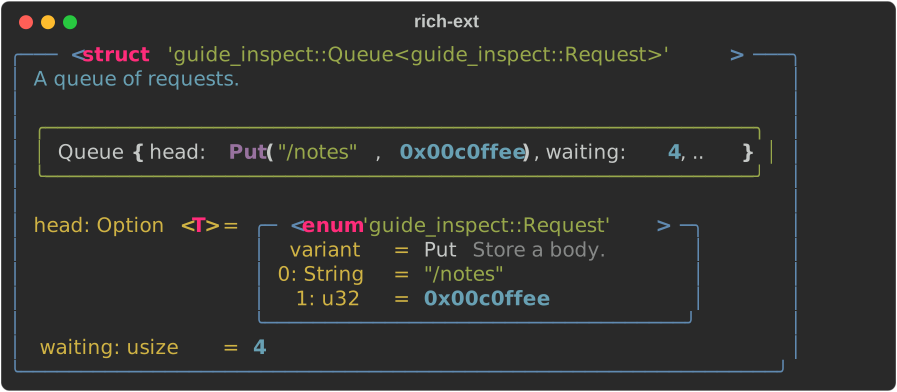
std::any::type_name, so it names the concrete type (Queue<guide_inspect::Request>); field types are as written (Option<T>). A type parameter used in a field gets aDebugbound on that field's type, as needed. - Unions are refused: which field holds the value isn't known.
Printing¶
// Print straight to standard output, as Python's `inspect(obj)` does.
inspect(&point, rich_ext::inspect::InspectOptions::new().all(true));
// The macro puts the expression in the title, and takes options.
rich_ext::rich_inspect!(point, value = false, methods = true);
inspect(&value, options) prints to standard output, as Python's
inspect(obj) does. rich_inspect!(value, name = option, …) does the
same, with the expression's source text in the title (point: <struct
'guide_inspect::Point'>).
Next to Python's¶
The same class in Python:
from dataclasses import dataclass
from rich import inspect

@dataclass
class Point:
    """A point in the plane.

    Only `help` shows this paragraph."""
    x: int
    y: float
    label: str
    _secret: int

    def norm(self, scale: float) -> float:
        """The length, scaled."""
        return (self.x ** 2 + self.y ** 2) ** 0.5 * scale

inspect(Point(3, 4.0, "origin", 7), methods=True, private=True)
With rich 15.0.0, at 80 columns:
╭─────────────────── <class '__main__.Point'> ───────────────────╮
│ A point in the plane.                                          │
│                                                                │
│ ╭────────────────────────────────────────────────────────────╮ │
│ │ Point(x=3, y=4.0, label='origin', _secret=7)               │ │
│ ╰────────────────────────────────────────────────────────────╯ │
│                                                                │
│   label = 'origin'                                             │
│ _secret = 7                                                    │
│       x = 3                                                    │
│       y = 4.0                                                  │
│    norm = def norm(scale: float) -> float: The length, scaled. │
╰────────────────────────────────────────────────────────────────╯
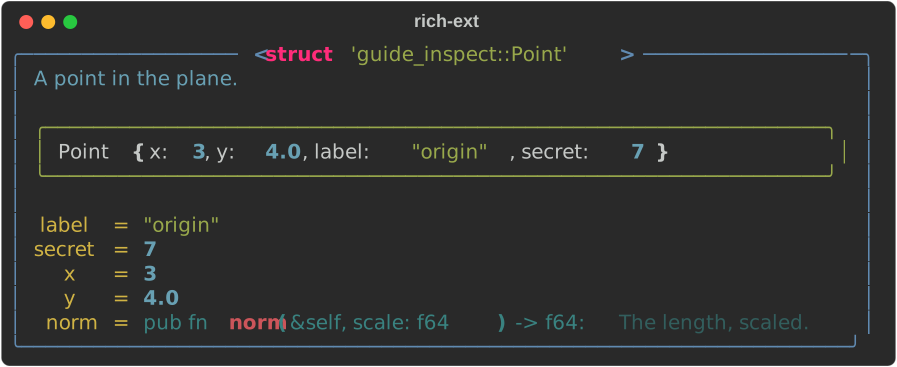
and the Rust struct above, with .methods(true).private(true):
╭────────────────── <struct 'guide_inspect::Point'> ──────────────────╮
│ A point in the plane.                                               │
│                                                                     │
│ ╭─────────────────────────────────────────────────────────────────╮ │
│ │ Point { x: 3, y: 4.0, label: "origin", secret: 7 }              │ │
│ ╰─────────────────────────────────────────────────────────────────╯ │
│                                                                     │
│  label = "origin"                                                   │
│ secret = 7                                                          │
│      x = 3                                                          │
│      y = 4.0                                                        │
│   norm = pub fn norm(&self, scale: f64) -> f64: The length, scaled. │
╰─────────────────────────────────────────────────────────────────────╯
What differs, and why (DIVERGENCES §19):
- The data comes from the derive, not from the live object; a type
without
#[derive(Inspect)](or a hand-writtenInspectable) can't be inspected. - Titles read
<struct '…'>or<enum '…'>with the fulltype_name, after Python's<class '…'>. - Values are
Debugoutput ("origin",4.0), not Python reprs, and there are nomax_length/max_stringcuts. - Methods are listed only from an
implblock marked#[inspect], with the receiver (&self) and visibility as written. Trait methods and associated constants are not listed. - No
dunder: Rust has no dunder names.privatemeans non-pub, not a leading underscore.allturns onmethods,private,typesandvariants, the Rust options it stands for. - Field doc comments follow their values when
docsis on (Python attributes have no docstrings).types,variantsandmax_depthare ours. - Inspecting a class, a function or a module has no counterpart: a Rust
type is not a value, so there is no
inspect(Point)and no callable's own signature line.
Run the example¶
See also¶
- Macros:
#[derive(Rich)], which renders a value as its own panel or table rather than reporting on it. Pretty: a value'sDebugoutput, highlighted.- API:
rich_ext::inspect,rs-rich-macros.