Quality assurance
rich_ext::qa tests how your output renders, not only what it says. It
renders a renderable through explicit capabilities, never the real terminal,
so results are the same on every machine and in CI.
| Module | Answers |
|---|---|
screenshot |
Did the output change? Approved text files, with a review workflow |
stress |
Does it survive every width and height? |
lint |
Is anything clipped, mis-styled, colour-only or unsupported by the target? |
explain |
Why did it wrap, truncate, lose colour or fall back to ASCII? |
profile |
How long do measure, render and a live refresh take, and how much do they allocate? |
fuzz |
Do random renderables break any invariant? |
matrix |
Does it hold across 16 terminal profiles? |
bench |
Did it get slower than the baseline? |
Everything here needs the testing feature. Add it as a dev-dependency so
it never reaches your release build:
The examples come from
guide_qa.rs:
They all use this fixture:
fn status_table() -> Table {
    let mut table = Table::new().title("Deployments");
    table.add_column("Service");
    table.add_column("Region");
    table.add_column("Status");
    let status = |markup: &str| Text::from_markup(markup).expect("valid markup");
    table.add_row_text(vec![
        Text::new("api"),
        Text::new("eu-west-1"),
        status("[green]✔ ok[/]"),
    ]);
    table.add_row_text(vec![
        Text::new("worker"),
        Text::new("us-east-2"),
        status("[red]✖ failed[/]"),
    ]);
    table
}
Wire it into cargo test
Each tool returns a report you can assert on, so a render test is an
ordinary #[test]:
#[cfg(test)]
mod tests {
    use super::*;
    use rich_ext::qa::fuzz::NodeKind;
    use rich_ext::qa::screenshot::assert_screenshots;

    #[test]
    fn status_table_screenshots() {
        // Approved files live in tests/screenshots/status-table/; run with
        // RICH_APPROVE=1 to accept new output.
        assert_screenshots("status-table", &status_table());
    }

    #[test]
    fn status_table_survives_common_widths() {
        let report = stress(&status_table(), &StressOptions::widths([20, 40, 80, 120]));
        assert!(
            report.is_clean(),
            "{}",
            Console::new().render_to_string(&report)
        );
    }

    #[test]
    fn status_table_lints_clean() {
        let findings = lint(&status_table(), &LintOptions::default());
        let report = LintReport::new(findings);
        assert!(!report.has_errors(), "{}", report.to_json());
    }

    #[test]
    fn fixtures_hold_across_unicode_terminals() {
        // The status symbols need Unicode: ASCII profiles fail.
        let profiles: Vec<_> = CapabilityProfile::standard()
            .into_iter()
            .filter(|p| p.unicode())
            .collect();
        let report = matrix::regression(FIXTURES, &profiles, 40);
        assert!(report.is_ok());
    }

    #[test]
    fn fuzzing_finds_nothing() {
        let options = GenOptions::default().kinds([NodeKind::Text, NodeKind::Table]);
        let report = fuzz_with(2024, 300, &options, &Invariants::default());
        assert!(report.is_clean(), "{:#?}", report.failures);
    }
}
The sections below explain each tool.
Screenshot approvals
Screenshot::capture(name, &renderable, &matrix) renders once per
combination of a Matrix: widths × colour depths × Unicode on or off. The
default matrix is 40, 80 and 120 columns × truecolor and no colour × Unicode
and ASCII, which gives 12 shots. Each Shot has a key such as
status-table@80.truecolor.unicode.
Approvals::new(dir) stores approved shots as <dir>/<name>/<key>.txt:
- no-colour shots are the plain text;
- colour shots are the ANSI output with escapes written visibly (
\e[1m), so the files are printable and diff line by line.
check(&shots) compares shots with those files. A shot that differs, or has
no approved file yet, is written beside it as <key>.new. The workflow:
- Run the tests. New or changed output fails, and
.newfiles appear. - Review the
.newfiles (or the diff in the failure message). - Rerun with
RICH_APPROVE=1to accept them.approve_all()does the same from code, andapproving(true)accepts during a check. - Commit the
.txtfiles. A later match removes stale.newfiles.
fn approval_workflow(dir: &Path) -> String {
    // Two widths, colour and no colour: four shots.
    let matrix = Matrix::default()
        .widths([30, 60])
        .color([ColorDepth::TrueColor, ColorDepth::None])
        .unicode([true]);
    let approvals = Approvals::new(dir);

    // First run: nothing approved yet, so every shot is "missing" and
    // written as `<key>.new` for review.
    let shots = Screenshot::capture("status-table", &status_table(), &matrix);
    let first = approvals.check(&shots).expect("readable directory");
    assert_eq!(first.missing.len(), 4);

    // Accept them (what RICH_APPROVE=1 does during a check).
    approvals.approve_all().expect("writable directory");

    // The renderable changes: the approved files no longer match.
    let mut changed = status_table();
    changed.add_row(&["cron", "eu-west-1", "paused"]);
    let shots = Screenshot::capture("status-table", &changed, &matrix.clone().widths([60]));
    let outcome = approvals.check(&shots).expect("readable directory");
    assert!(!outcome.is_ok());
    outcome.report() // a summary, then a diff per mismatch
}
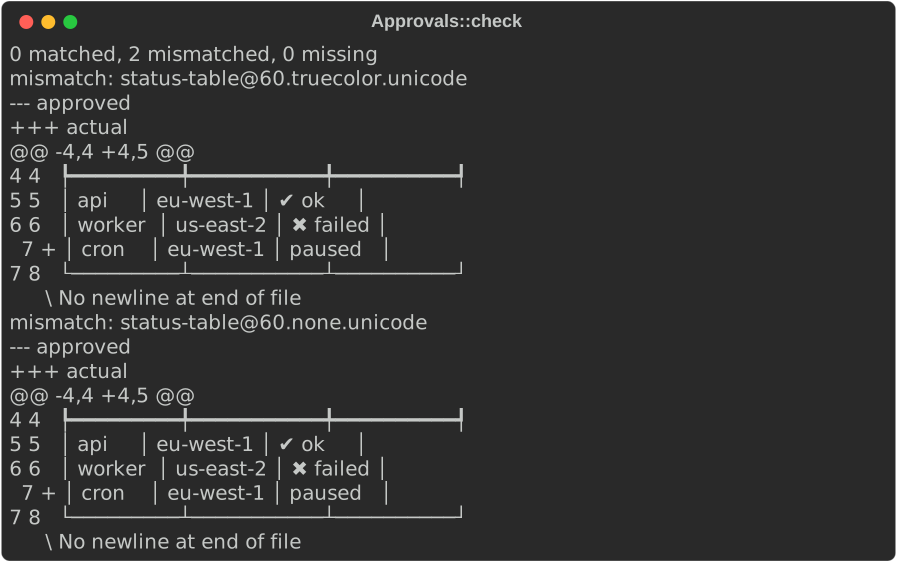
assert_screenshots(name, &renderable) does all of this with the default
matrix. It keeps files in RICH_SCREENSHOT_DIR, else
$CARGO_MANIFEST_DIR/tests/screenshots, and panics with the diffs.
assert_screenshots_with(&approvals, name, &renderable, &matrix) takes your
own directory and matrix.
Stress
stress(&renderable, &options) renders at many widths and heights and
reports:
- overflow: a line wider than the width;
- clipping: content lost compared with a wide render;
- unstable wrapping: more lines at a larger width;
- panics;
- measure mismatch: output that disagrees with
measure().
StressOptions::default() uses widths 1, 2, 3, 4, 10, 20, 40, 80, 120 and
200, with the height unset, 5 and 24. StressOptions::widths([…]) picks
widths with the height unset.
fn show_stress(console: &Console) {
    let report = stress(&status_table(), &StressOptions::widths([3, 8, 20, 40, 80]));
    if !report.is_clean() {
        console.print(&report);
    }
}
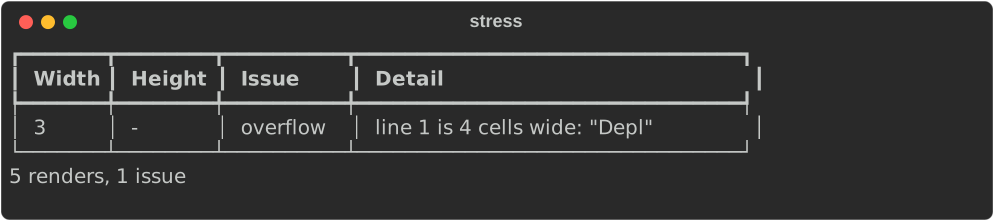
report.is_clean() is the usual assertion. report.of(IssueKind::Overflow)
filters the issues by kind.
Lint
lint(&renderable, &LintOptions) renders for a described target and checks:
- layout: stress at the lint widths (default 20, 40 and 80);
- hyperlinks: empty, malformed or unsafe URLs (
javascript:), unknown schemes, and links with blank text; - colour-only distinctions: the same status symbol or word (
●,✔,ok,error, …) in two colours with nothing else to tell them apart; - capabilities: colours deeper than the target, non-ASCII glyphs on an
ASCII target, links on a target without OSC 8, and
blink.
A theme name that does not exist renders as nothing, so it cannot be found
after rendering. lint_markup(markup, &theme) and lint_text(&text, &theme)
check the source instead and suggest the nearest name.
fn show_lint(console: &Console) {
    // Markup is checked against a theme: typos get the nearest name.
    let theme = rich_ext::extended_theme();
    let mut findings = lint_markup("[bold gren]ready[/] [repr.nubmer]42[/]", &theme);

    // A render is checked at each width for a described target.
    let options = LintOptions::default().widths([12, 40]).unicode(false);
    let status =
        Text::from_markup("[green]● ok[/] [red]● failed[/] [link=htps://example.com]docs[/]")
            .unwrap();
    findings.extend(lint(&status, &options));

    let report = LintReport::new(findings);
    let _json = report.to_json(); // for CI annotations
    console.print(&report);
}
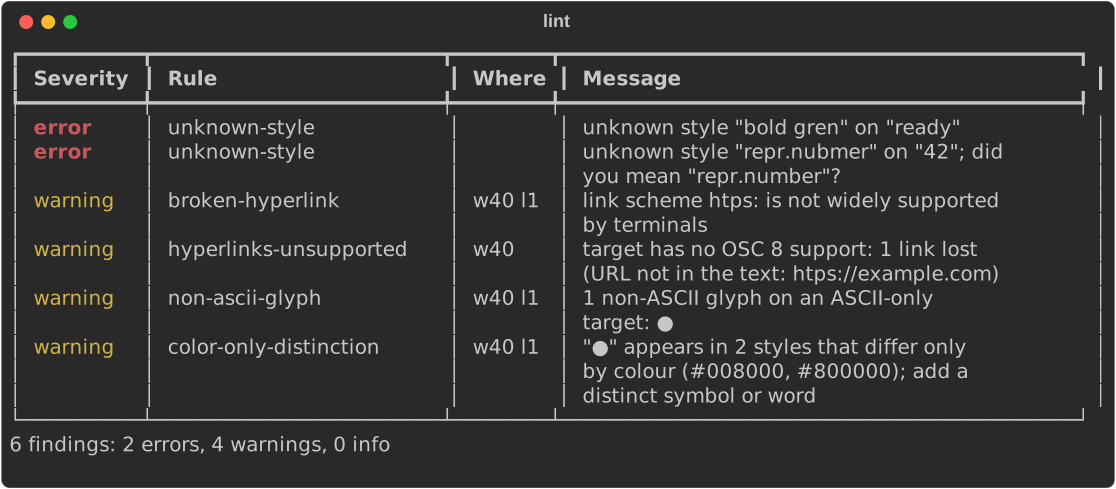
LintOptions::default() describes a 16-colour Unicode terminal without
links. LintOptions::capable() describes truecolor with links. Adjust with
widths, color, unicode, hyperlinks and layout. LintReport counts
findings by severity, has has_errors(), and round-trips through
to_json() / from_json() for CI annotations.
Explain
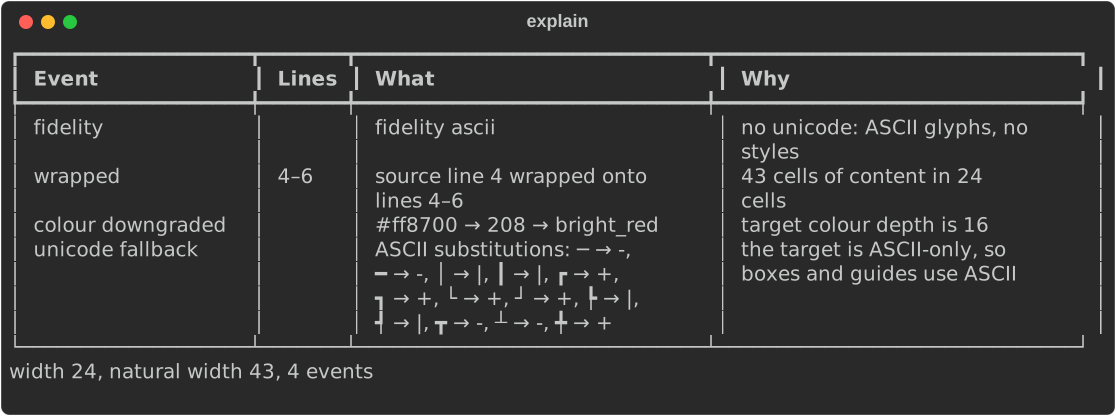
explain(&renderable, &target) answers "why does it look like that?" for a
RenderTarget. It reports which lines wrapped and from where, truncation and
cropping, each colour downgrade with its mapping (#ff8700 → 208 →
bright_red), the fidelity level and why, ASCII substitutions, and dropped
links. explain_console explains for an existing console, and
explain_with_report adds each capability's source from a
capability report.
fn show_explain(console: &Console) {
    let mut table = Table::new();
    table.add_column("Step");
    table.add_column("Result");
    table.add_row_text(vec![
        Text::from_markup("[#ff8700]deploy[/]").unwrap(),
        Text::new("finished in 42s with no errors"),
    ]);
    // A 16-colour, ASCII-only terminal, 24 columns wide.
    let target = RenderTarget::new(
        TargetKind::Terminal,
        TargetCapabilities {
            width: 24,
            height: 24,
            color_system: Some(ColorSystem::Standard),
            interactive: true,
            unicode: false,
            hyperlinks: false,
            sixel: Support::Unsupported,
        },
        Theme::default_theme(),
    );
    let explanation = explain(&table, &target);
    console.print(&ExplanationView::new(&explanation));
}
Profile
profile(&renderable, &console, &options) times measure() and
rich_render() over iterations runs (default 20, after 2 warm-up runs). It
counts segments, lines, cells and ANSI bytes. With frame(width, height) it
also times a live-style refresh: render at a fixed size, shape to exactly
that many rows and encode, as Live does on every frame.
To count allocations, install CountingAllocator as the global allocator of
the test or bench binary. The library never installs it:
use rich_ext::qa::profile::CountingAllocator;

// In a test or bench binary, never in a library.
#[global_allocator]
static ALLOC: CountingAllocator = CountingAllocator::system();
fn run_profile(console: &Console) -> Profile {
    let options = ProfileOptions::default()
        .iterations(50)
        .width(60)
        .frame(60, 10); // also cost a Live-style 60x10 refresh
    let profile = profile(&status_table(), console, &options);
    // Filled in because this binary installs CountingAllocator.
    assert!(profile.allocations.is_some());
    profile
}

fn show_profile(console: &Console, profile: &Profile) {
    console.print(&ProfileReport::new(profile));
}
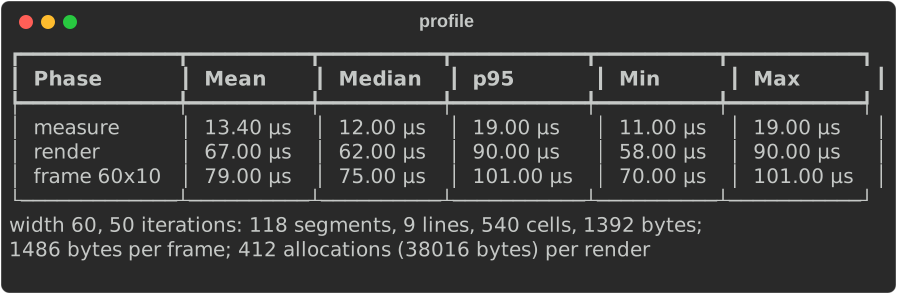
The counters are process-wide. Parallel tests allocate at the same time, so
treat the numbers as an upper bound, or run with --test-threads=1. The
numbers in the screenshot are made up, so this page does not change with
the machine that built it.
Fuzz
fuzz(seed, cases, &invariants) generates random renderable trees from a
seed: styled text with wide, combining and zero-width characters, tables,
panels, padding, alignment, columns and trees. It renders each tree at a
random width and checks the Invariants:
- no panic;
- no line wider than the width;
- a second render is identical;
measure()bounds hold;- your own checks, added with
custom(name, check).
A failure is shrunk while the same invariant still fails. It keeps its seed
and case index, so Case::generate(seed, index, &options) rebuilds it
exactly, and failure.minimized is a Rust reproduction to paste into a
test. fuzz_with takes GenOptions: widths, depth, children, words, a
shrink budget, and which node kinds to generate (kinds, without).
fn show_fuzz(console: &Console) {
    // Every node kind, widths 4 to 40.
    let options = GenOptions {
        min_width: 4,
        max_width: 40,
        ..GenOptions::default()
    };
    // The default invariants, plus one of our own.
    let invariants = Invariants::default().custom("no-tabs", |r: &Rendered<'_>| {
        match r.lines.iter().position(|line| line.contains('\t')) {
            Some(i) => Err(format!("line {} contains a tab", i + 1)),
            None => Ok(()),
        }
    });
    let report = fuzz_with(7, 60, &options, &invariants);
    console.print(&report);
    for failure in &report.failures {
        // Rebuild the exact case from its seed and index...
        let case = Case::generate(failure.seed, failure.case_index, &options);
        assert_eq!(case, failure.case);
        // ...or paste the shrunk reproduction into a test.
        println!("{}", failure.minimized.as_deref().unwrap_or(""));
    }
}

A failure lists the case, the width, the broken invariant and a shrunk reproduction you can paste into a test, like this one:
That reproduction is from a real bug the fuzzer found: Columns used to
overflow with an item wider than the width, and Tree guides overflowed
below about 8 columns. Both are fixed in core, matching rich 15.0.0.
Capability matrix
matrix::regression(fixtures, &profiles, width) renders each fixture under
each CapabilityProfile and checks the structure: nothing wider than the
width, no colour codes on a no-colour profile, no OSC 8 links on a no-link
profile, and no non-ASCII on an ASCII profile. CapabilityProfile::standard()
is 16 profiles: 16, 256 and truecolor × Unicode or ASCII × links or not,
then dumb, ci, windows-terminal and screen-reader.
A fixture is a name and a fn() -> Box<dyn Renderable>:
fn fixture_table() -> Box<dyn Renderable> {
    Box::new(status_table())
}

fn fixture_panel() -> Box<dyn Renderable> {
    Box::new(Panel::new(Box::new(Text::styled("all systems go", "green"))).title("Status"))
}

const FIXTURES: &[Fixture] = &[("table", fixture_table), ("panel", fixture_panel)];

fn show_matrix(console: &Console) {
    // 12 colour × unicode × link combinations, then dumb, ci,
    // windows-terminal and screen-reader.
    let profiles = CapabilityProfile::standard();
    let report = matrix::regression(FIXTURES, &profiles, 40);
    console.print(&report);
    for cell in report.failures() {
        eprintln!("{} under {}: {:?}", cell.fixture, cell.profile, cell.status);
    }
}
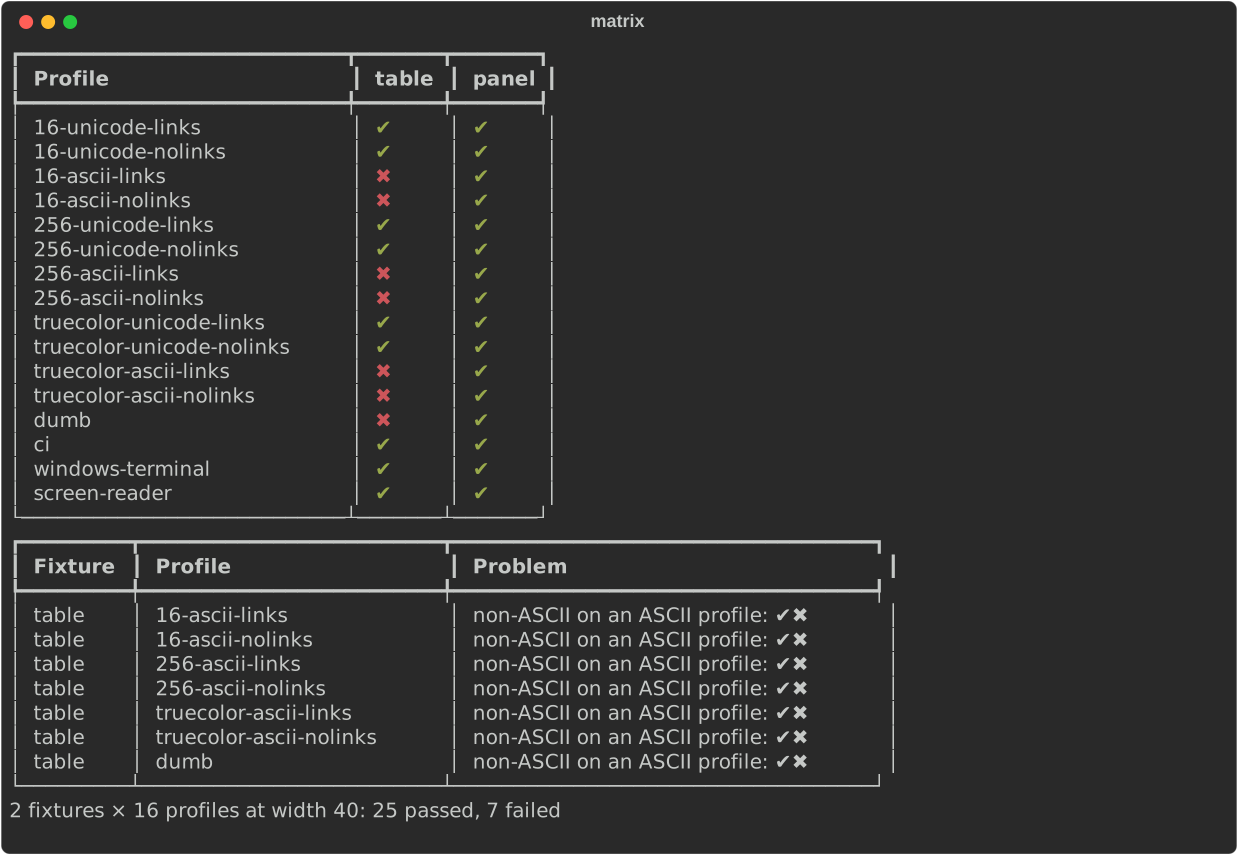
The status table fails on ASCII profiles because ✔ and ✖ are not ASCII.
Pick status symbols per profile with an
AccessibilityPolicy, or wrap the output in
Degrade.
matrix::run(…, Some(&approvals)) also checks every cell against approved
screenshots.
Benchmarks
Bench::new(name).run(|| …) samples a closure until a target time (default
1 s, at least 10 samples) and returns a Measurement with the mean, median,
standard deviation, p95, min and max. bench_renderable(name, &renderable,
width) benchmarks a render plus ANSI encoding. A BenchRun holds the
measurements and saves to a stable JSON format (save, load). It can also
read criterion output with from_criterion_dir.
compare(&baseline, &candidate, &CompareOptions) gives each benchmark a
verdict: regression, improvement, unchanged, new or removed. A change must
exceed threshold_pct (default 5) and, by default, the combined standard
deviation. ComparisonView renders it with a min/median/p95/max sparkline
per side.
fn record_bench(path: &Path) -> std::io::Result<()> {
    let table = status_table();
    let run = BenchRun::new(vec![
        bench_renderable("status-table@80", &table, 80),
        bench_renderable("status-table@40", &table, 40),
    ]);
    run.save(path) // JSON; `rich bench compare` reads it
}

fn show_comparison(console: &Console, baseline: &BenchRun, candidate: &BenchRun) -> bool {
    let options = CompareOptions {
        threshold_pct: 10.0,
        ..CompareOptions::default()
    };
    let comparison = compare(baseline, candidate, &options);
    console.print(&ComparisonView::new(&comparison));
    comparison.has_regressions()
}
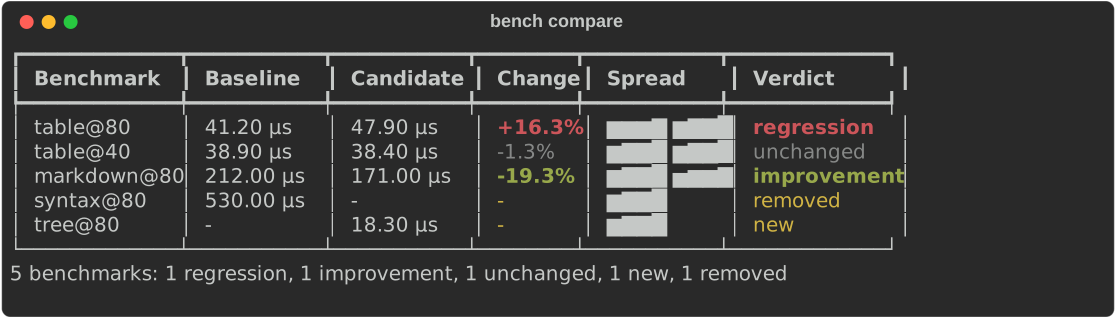
From the command line, rich bench compare BASE CAND [--threshold PCT]
prints the same table and exits with status 5 when anything regressed, which
makes it a CI gate:
rich bench compare baseline.json candidate.json --threshold 10
rich bench compare target/criterion-main target/criterion
Gotchas
- Determinism. Every tool renders through capabilities you pass, never the environment. Fix the widths and profiles in tests, and do not assert on timings.
- Approval files for colour shots are escaped ANSI. Review them as text:
\e[1;31mred\e[0mis the escape it looks like. RICH_ASSERT_COLORcontrols colour in approval diffs, as it does for the assertion macros.- Natural width.
explaintakes the natural width frommeasure()at a very wide probe. CoreTableandPaneldo not implementmeasure()yet, so for them the summary line reports the probe's width (1000), as in the screenshot above. The wrap events themselves count the real content width.
See also
rich_ext::qaon docs.rsqa::screenshot,qa::fuzz,qa::bench- Diffs and test reports: the diffs in failure messages, and assertion macros
- Capabilities and fidelity: the profiles and targets these tools render for
- Accessibility: status symbols that pass the matrix