Terminal compatibility
A micro asset always takes exactly its cells. What fills them depends on
the terminal, chosen once per terminal by rich_micro::select (see
Drawing on a terminal): Kitty, then
iTerm2, then Sixel, then half-blocks, then the emoji or text fallback.
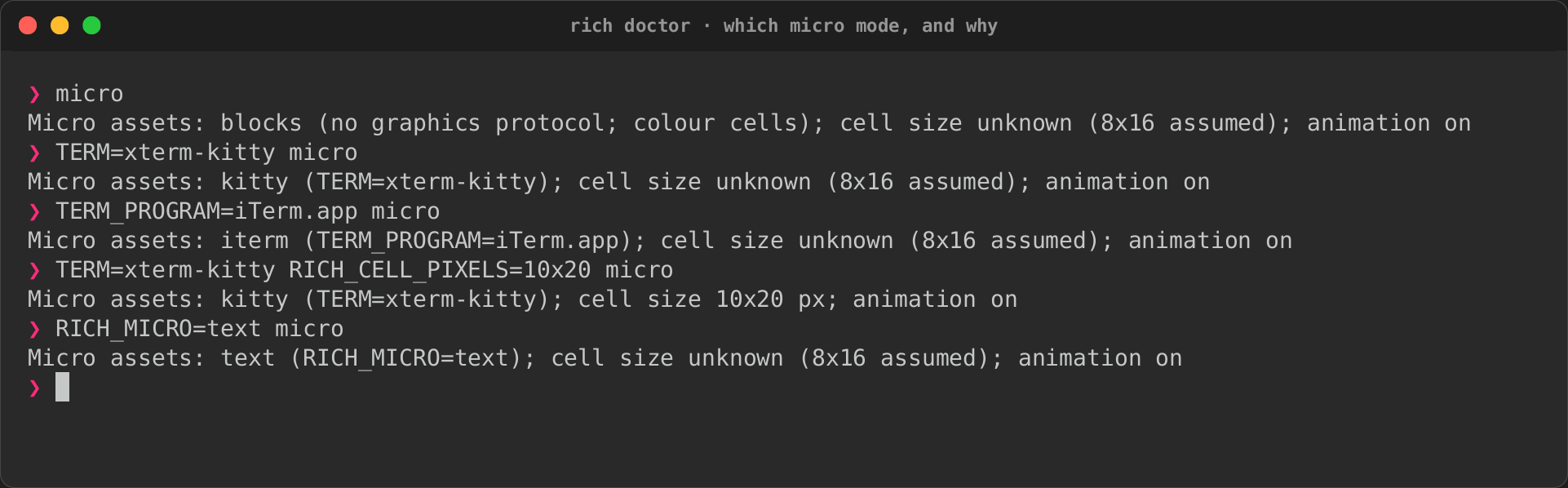
rich doctor says which one it picked and why (micro in
--report json), and rich micro preview shows the result.
The matrix
| Terminal | Drawn with | Animation | Notes |
|---|---|---|---|
| kitty | Kitty Unicode placeholders | native (Kitty frames) | images live in the cell grid: they scroll, survive redraws, and are sent once per session |
| Ghostty | Kitty placeholders with RICH_MICRO=kitty |
native | Ghostty speaks Kitty's protocol but is not detected as kitty |
| WezTerm | iTerm2 inline images (detected); Kitty with RICH_MICRO=kitty |
native (GIF) | |
| iTerm2 | iTerm2 inline images | native (GIF) | |
| Konsole | Kitty with RICH_MICRO=kitty, else half-blocks |
native with Kitty | |
foot, mlterm, Windows Terminal ≥ 1.22, mintty, xterm -ti vt340 |
Sixel, once the cell size in pixels is known | frame by frame, on redraw | Sixel is used only when the terminal is found (or said) to support it |
| Alacritty, GNOME Terminal (VTE), Terminal.app, the Linux console with colour | the emoji fallback; half-blocks with RICH_MICRO=blocks |
frame by frame (blocks) | no image protocol |
| tmux, GNU screen | the emoji fallback unless passthrough is configured | — | set RICH_MICRO=blocks or text, or allow passthrough and set RICH_MICRO to the outer terminal's protocol |
TERM=dumb, no colour |
the emoji in UTF-8 output, else the text fallback, else the alt text | none | |
pipes, log files, --export-html/--export-svg, --pager, captures |
the fallback (the emoji in UTF-8 output, else the text), byte for byte | none | never an escape sequence, whatever RICH_MICRO says; with an export or the pager, rich -p prints the fallback on the terminal too |
"Native" animation is played by the terminal itself; "frame by frame"
means the frame that is due is drawn whenever the view redraws (a live
region, an interactive view), and a printed line keeps the frame it was
printed with. RICH_A11Y=reduced-motion and RICH_ANIMATION=0 always show
the still image.
Overrides
| Variable | Effect |
|---|---|
RICH_MICRO=kitty\|iterm\|sixel\|blocks\|text |
Use this way on a terminal (never off one). blocks draws half-blocks from the image before the emoji; text never draws images |
RICH_CELL_PIXELS=WxH |
The cell size images are fitted to, when the terminal does not report it |
RICH_GRAPHICS, RICH_SIXEL |
The graphics protocol detection rich --image uses, which micro assets share |
RICH_ANIMATION=0, RICH_A11Y=reduced-motion |
Still images only |
Checking your terminal
$ rich doctor --report json | jq .micro
$ rich micro preview status/loading
$ RICH_MICRO=kitty rich micro preview status/success
rich doctor names the mode and why. Recorded with the variables each
terminal sets put in by hand (the recorder's own terminal draws no images,
so this shows the choice, not the drawing):
If an image protocol draws garbage (a terminal that claims one it does not
have, or a multiplexer in the way), set RICH_MICRO=blocks or text in
your shell profile. Layout never changes with the choice: every mode puts
exactly the asset's columns in the line.
What CI sees
The documentation's recordings come from rich record, a pseudo-terminal
with no image protocol, so they show the emoji fallback (and half-blocks
where a tape sets RICH_MICRO=blocks). The per-protocol PTY tests in
crates/rich-micro/tests/pty.rs check the Kitty, iTerm2 and Sixel bytes and
cursor positions through an emulator; the protocols themselves are checked
by hand in real Kitty, iTerm2 and a Sixel terminal before a release.
WebP and frame-sequence animations draw their still image in this release, and every asset is one row high.